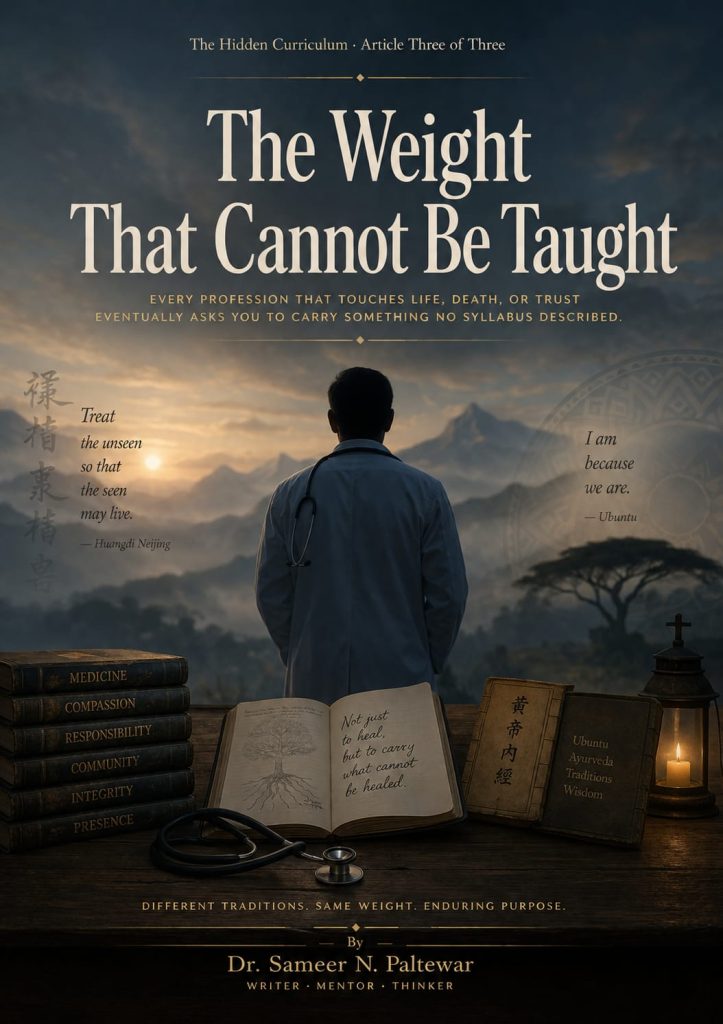
The Hidden Curriculum Article Three of Three
The Weight That Cannot Be Taught
Every profession that touches life, death, or trust eventually asks you
to carry something no syllabus described.
The Weight with No Name in Any Textbook
The hidden curriculum of any profession is not only about skills. Contracts can be learned. Balance sheets can be read with practice. Cameras can, eventually, be faced without flinching. But there is a final subject that sits beneath all the others, one that arrives late, uninvited, and impossible to prepare for in advance — the weight of carrying decisions that cannot be undone, for people who will never fully know what that carrying cost.
Every healing tradition on earth has quietly built a container for this weight, because every healing tradition eventually discovered that competence alone cannot hold it.
The Physician Who Treats What Has Not Yet Appeared
The Huangdi Neijing, the foundational text of Chinese medicine compiled roughly two thousand years ago, contains a line that has unsettled physicians in every generation since it was written. The superior physician treats the disease that has not yet arisen. The mediocre physician treats the disease that is about to arrive. The inferior physician treats the disease that has already struck.
Read quickly, this sounds like a straightforward hierarchy of prevention over cure. Read slowly, it describes something closer to a burden than an achievement. The superior physician, in this framework, spends a career acting on threats invisible to everyone else in the room — including, often, the patient — and receives credit for exactly none of the disasters that never happened because of what he quietly did. There is no gratitude economy for a catastrophe successfully prevented. There is no photograph taken, no relieved family in the corridor, because nothing visible occurred. The Neijing was not merely teaching medicine. It was warning its readers, two millennia in advance, that the finest work in this profession would often be invisible even to the person it saved.
“The superior physician treats the disease that
has not yet arisen — and receives credit for
exactly none of the disasters that never happened.”
I Am Because We Are
In the philosophical traditions of Southern Africa, gathered under the word Ubuntu, personhood itself is defined relationally: umuntu ngumuntu ngabantu — a person is a person through other persons. Identity, in this framework, is not something one carries alone into a room. It is something continuously built and rebuilt in the presence of others, and it comes with an obligation attached that Western individualism rarely names as clearly: your competence is not fully your own. It was made possible by, and is owed back to, the community that shaped it.
A physician trained inside an Ubuntu understanding of personhood would find the entire premise of professional burnout slightly foreign — not because the exhaustion isn’t real, but because the isolation compounding it would be seen as the deeper failure. The weight was never supposed to be carried alone. It was always meant to be distributed across a community wide enough to hold it. Modern medical practice, increasingly private, increasingly individual, increasingly measured by solitary metrics on a solitary dashboard, has in many places quietly abandoned this older architecture — and then acts surprised when the weight it never redistributed eventually breaks the person left holding all of it.
Every Vocation Carries Its Own Version
This weight is not unique to medicine. It belongs to every profession that touches life, death, justice, safety, or the fragile architecture of human trust. Firefighters carry the rooms they could not enter in time. Soldiers carry the dawns that arrived for them and did not arrive for someone beside them. Teachers carry the children who quietly disappeared from the classroom roll and were never seen again. Parents carry the words they meant to say and, for reasons even they cannot fully explain, did not.
The hidden curriculum of adulthood is, in the end, learning to stand upright under a burden that no certificate ever warned you to expect. Different cultures have built different scaffolding to hold it — the Neijing’s quiet warning about invisible prevention, Ubuntu’s insistence that no one was ever meant to hold it alone, Ayurveda’s fourth pillar of shuchi, integrity of conduct maintained precisely because no one is watching to enforce it. The scaffolding differs. The weight they are all built to hold is the same weight, recognised independently, on every continent, by every tradition that ever took healing seriously.
Not a Flaw, But a Feature
And yet this weight is not a defect in the design. It is a feature of what it means to do work that genuinely matters. A profession light enough to carry without strain is usually a profession that changes very little in the lives it touches. The weight is, in an uncomfortable sense, the receipt for consequence — proof that what you did was real enough to matter, heavy enough to leave a mark, serious enough that getting it wrong would have cost something irreplaceable.
The question the hidden curriculum never quite finishes asking is not how to avoid this weight. It is how to carry it without being crushed by it, and without quietly setting it down on someone who never agreed to hold it — a spouse, a child, a junior colleague who deserved a mentor and received a wound instead.
The Final Subject
If you have just graduated and feel unprepared for the world outside the textbook, you are not inadequate. You have simply reached the point where formal education ends and a much older, much less forgiving curriculum begins. Keep studying — not only your discipline, but people, finance, negotiation, leadership, and the strange, luminous art of remaining present for another human being on the worst day of their life. Above all, study how to carry weight without either dropping it or being destroyed by it, because every tradition that ever took this work seriously eventually had to teach that same lesson, in its own language, to every generation that followed.
Your greatest professional asset will never be the certificate hanging on the wall behind you. It will be your capacity to keep learning, and keep carrying, long after formal education has stopped issuing any further instructions.
Perhaps the real graduation ceremony does not happen on the day a university hands you a certificate. Perhaps it happens years later, in an ordinary corridor, at an hour with no clock worth checking, when you finally understand that every patient teaches medicine — but life, in its many unrelated languages across every tradition that has ever tried to name this weight, teaches the physician.
And that particular teacher never once stops speaking.
By