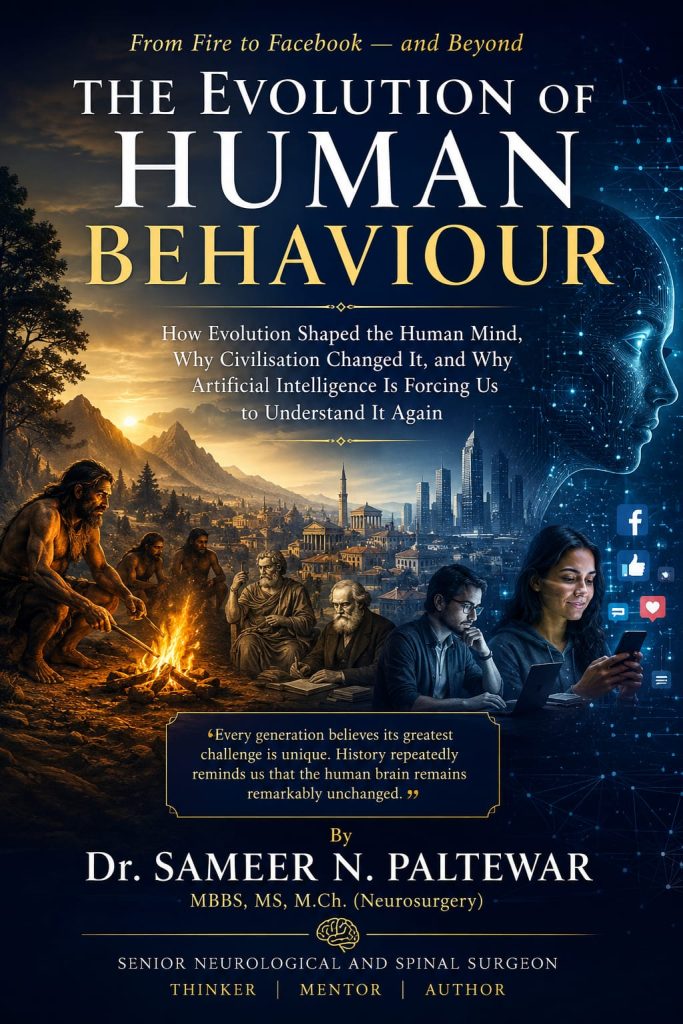
THE EVOLUTION OF HUMAN BEHAVIOUR
From Fire to Facebook — and Beyond
How Evolution Shaped the Human Mind, Why Civilisation Changed It, and Why Artificial Intelligence Is Forcing Us to Understand It Again
By
Dr. Sameer N. Paltewar
WRITER · MENTOR · THINKER
Prologue
When Success Becomes Survival
“Every generation believes its greatest
challenge is unique. History repeatedly
reminds us that the human brain remains
remarkably unchanged.”
In the summer of 2026, India lived through a familiar cycle of hope, outrage, and despair. Allegations of irregularities in one of the country’s most competitive entrance examinations triggered protests that spread from campus WhatsApp groups to Jantar Mantar within days. Students demanded justice. Parents demanded accountability. Courts were drawn in. A government defended itself before eventually yielding to public pressure, and a cabinet minister resigned. Social media erupted in celebration — victory, people called it, over institutional arrogance.
Behind the headlines, a quieter and far more devastating story was unfolding. Young people, some barely eighteen, began taking their own lives. A nineteen-year-old wrote ‘I am sorry’ on a plain sheet of paper the day before a re-test she feared she could not survive. A seventeen-year-old, who had scored eighty-five percent in his board examinations, jumped from the sixth floor of his residential building. A young aspirant in Nagpur left behind a note naming the examination itself as the reason she could no longer continue.
For these students, medicine had ceased to be a career choice. It had become an identity — the only one they believed they possessed. When the examination became uncertain, their future became uncertain. For a few, unbearably, life itself became uncertain.
As a neurosurgeon, I have stood beside patients whose lives changed within seconds — a ruptured aneurysm, a bleed nobody could have predicted, a tumour discovered a year too late. That work teaches an uncomfortable truth with total clarity: the human body is astonishingly fragile. But there is another fragility we discuss far less often, one that no MRI can measure and no blood test can detect.
The fragility of hope
Hope determines whether a patient fights an illness, whether a scientist pursues an idea that colleagues consider absurd, whether a nation rebuilds after disaster — and whether an eighteen-year-old, alone in a room at midnight, chooses to face tomorrow. Why should a single examination possess such extraordinary power over that choice? The answer cannot lie in education policy alone. It cannot lie in politics or economics alone. It lies somewhere far older, buried deep inside the architecture of the human brain itself.
To understand why a mark sheet can feel heavier than life, we must travel back — not years, not centuries, but millions of years, to a time before schools existed, before governments existed, before language itself had fully taken shape. Because the story of a modern teenager’s despair began, improbably, around an ancient fire.
Part I
The First Reward — How Hunger Invented the Human Mind
Long before human beings-built cities, composed symphonies, or debated philosophy, they faced a far simpler question every single morning. What shall we eat today? Would fruit still be on the branch. Would the herd return. Would the river yield fish. Would a poisonous root be mistaken, fatally, for a nourishing one.
Survival depended not on intelligence alone but on making the right decision, repeatedly, without the luxury of a second attempt. Nature faced a remarkable engineering problem: how do you persuade an organism to perform behaviours essential to its survival without requiring it to first understand biology? Evolution’s solution was breathtakingly elegant. It made survival pleasurable. Sweetness rewarded sugar. Umami rewarded protein. Fat rewarded concentrated energy. Pleasure became biology’s oldest teacher, and long before any school taught arithmetic, evolution was already conducting its lessons through the chemistry of dopamine.
The first classroom was the forest. The first examination was hunger. The first report card was simply whether you survived to see another season.
Charles Darwin showed that natural selection designs nothing with the future in mind — there is no engineer planning tomorrow’s species, only tiny advantages accumulating, generation after generation, without anyone choosing them on purpose. Individuals who happened to prefer nutritious food survived more often than those who did not, and their preferences quietly became the preferences of everyone descended from them.
The Fire That Rewrote the Brain
Evolutionary biologists Rob Dunn and Monica Sanchez have proposed something genuinely startling: that one of humanity’s greatest technological leaps — the controlled use of fire — may have been driven less by calories than by flavour itself. Cooking chemically transforms food. The Maillard reaction releases hundreds of aromatic compounds that simply do not exist in raw meat or an uncooked root. Those aromas made cooked food irresistible, and our ancestors likely kept returning to the fire because it tasted better, long before anyone understood nutrition or microbiology.
The hidden rewards followed quietly behind the obvious one — fewer pathogens, easier digestion, more available calories, and eventually the metabolic surplus required to grow a dramatically larger brain. Evolution never announced any of this. It simply whispered, this tastes better, and let the consequences accumulate across a hundred thousand years.
What Ayurveda Knew About the Tongue
It is worth pausing here on a parallel discovery made an ocean and several millennia away. The ancient science of Ayurveda organised the entire universe of taste into six categories madhura (मधुर), amla (अम्ल), lavana (लवण), katu (कटु), tikta (तिक्त), and kashaya (कषाय) sweet, sour, salty, pungent, bitter, and astringent – and insisted that a meal balancing all six was not merely more pleasurable but more healthful. Charaka, compiling this system in the early centuries of the common era, was describing in the language of philosophy exactly what Darwin would later describe in the language of biology: that taste is not decoration. It is instruction. The tongue, in both traditions, is not a pleasure organ bolted onto survival. It is survival’s oldest and most trusted advisor.
“The tongue is not a pleasure organ bolted
onto survival. It is survival’s oldest and most
trusted advisor.”
Over thousands of generations, this sensory machinery grew more sophisticated than its original brief required. The same circuits that once recognised nourishing fruit began, almost as a side effect, to recognise trustworthy faces. The same curiosity that explored a forest began exploring ideas. The same reward system that reinforced a successful hunt began rewarding invention, cooperation, and discovery. Hunger, given enough time, quietly transformed into curiosity. Curiosity became intelligence. Intelligence became civilisation.
But evolution had planted a second, more dangerous seed alongside the first. If pleasure could motivate behaviour, so too could desire — and desire, unlike hunger, does not always announce what it actually wants. Nearly two thousand years after the first cities rose along the Indus and the Nile, an Austrian physician in Vienna would spend a career trying to answer exactly that question. His name was Sigmund Freud, and he believed that beneath every human achievement burned a fire nobody could see.