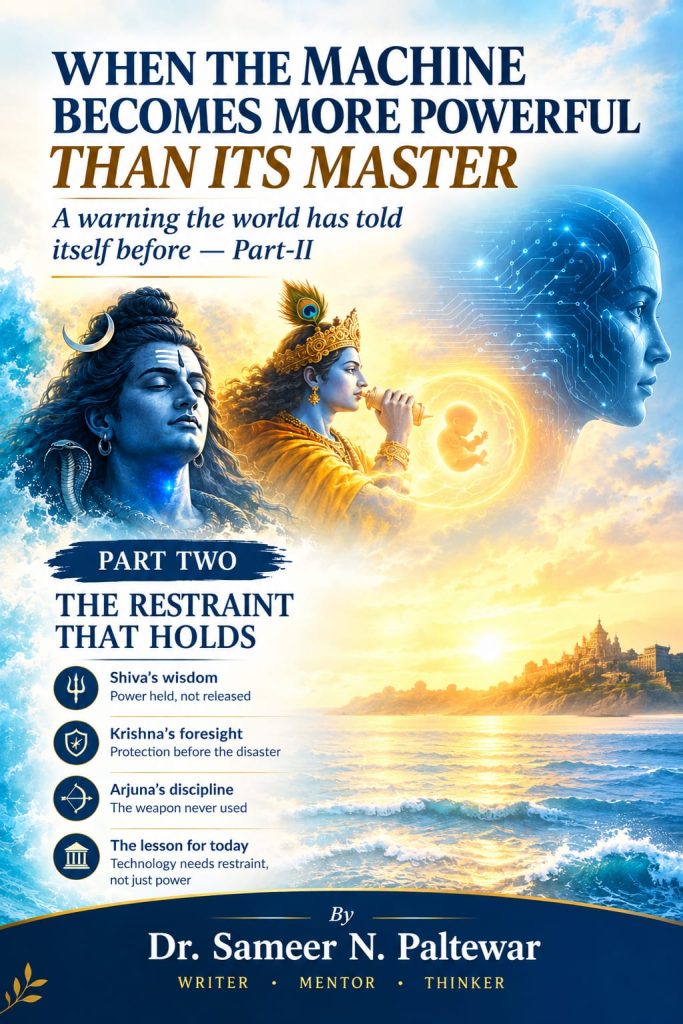
WHEN THE MACHINE BECOMES MORE POWERFUL THAN ITS MASTER A warning the world has told itself before —Part-II
By
Dr. Sameer N. Paltewar
WRITER · MENTOR · THINKER
PART TWO
THE RESTRAINT THAT HOLDS
Two disasters were left hanging at the end of Part One: a poison rising out of the ocean with nowhere to go, and a weapon already in flight toward a womb, already unstoppable. Both stories were written by people who understood something we’re only now relearning — a story about power isn’t finished until it tells you who was close enough, and ready enough, to step in before the ending wrote itself.
Both stories answer that question. Neither answer was an accident.
Neelkantha: the god who held the line
Only Shiva stepped forward.
He didn’t spit the poison out to save himself. He didn’t swallow it either. He held it — right at his throat — where it could neither escape into the world nor go any further into him. His throat turned blue. Neelkantha, they called him. The blue-throated one. The god who took an unbearable power and chose neither to reject it nor be consumed by it, but to hold it, in careful balance, forever.
Only then did the churning start again. Only then did the nectar come.
The same churning that nearly destroyed the world also produced the drink of immortality. The ocean didn’t choose which one it would be. Shiva did.
That’s the oldest version of a story we’re living through again. It’s why Part One wasn’t the whole story. Every myth we’ve walked through so far ends in damage because nobody stood at the threshold. This part is about what happens when someone finally does.
Krishna: help that was already in position
The weapon Ashwatthama fired doesn’t disappear because the story needs it to. It arrives. It burns toward its target exactly as a Brahmastra is meant to. And right where the epic’s own rules say nothing more can be done, Krishna — who spends the whole Mahabharata acting one step ahead of disaster — enters the womb himself and shields the unborn child from the full force of the weapon.
The child, Parikshit, is born dead. Krishna brings him back to life. The bloodline, seconds from complete extinction, survives — not because the weapon was somehow less real, and not because Ashwatthama’s fury was somehow less total, but because something capable of stepping in was already there, before the disaster arrived.
Krishna didn’t stop the weapon by being stronger than it. He stopped it by already being exactly where it was going to land.
That’s a different kind of restraint from Shiva’s, and the difference matters. Neelkantha is the one who holds the power himself. Krishna is the safeguard that exists independently of whoever lost control — because by the time grief has already fired the weapon, hoping the shooter comes to his senses isn’t a plan. It only works if it was already in place.
Ashwatthama is cursed afterward to wander the earth forever, wounded and unable to die. Some uses of power can’t be undone — only marked. But the child lives. The Mahabharata is drawing a clear line across these two stories: restraint built into the person holding the power is the first and best safeguard. A rescuer already positioned at the point of impact is the second. It’s the only reason this particular story doesn’t end in extinction.
The weapon that was never handed over lightly
Arjuna’s relationship with the same kind of weapon shows what the first safeguard looks like when it actually holds.
Arjuna spent years earning the Pashupatastra from Shiva himself — a weapon that could end the world. Shiva tested his discipline before granting it, and attached a condition: never use it except against a threat of equal size, never in anger, never lightly. Arjuna carried it through an entire war and, through sheer restraint, never used it at all.
The power was real. The limit on it was chosen deliberately, before the power was ever granted — not improvised afterward, in a panic, once it was already moving on its own.
Set beside Ashwatthama, the contrast is stark. Both men carried a version of the same weapon, in the same war, under the same broad tradition. One carried his for eighteen days and never fired it. The other reached for his in a single night of grief and nearly wiped out a bloodline. The weapon didn’t decide the difference. What had, and hadn’t, been built into each man before the weapon reached his hands decided it.
Two craftsmen, one sky
Greek myth tells a quieter version of the same lesson — a father who got it right, and a son who didn’t, echoing Phaethon’s disaster on a smaller, more personal scale.
Prometheus stole fire from the gods and gave it to people — the forge, the hearth, the lamp by which we first wrote things down. He paid for it, chained to a rock. Fire itself stayed exactly what it had always been: just as capable of lighting a home as burning a city. The gift didn’t come with instructions for using it wisely. That part was left to us.
His nephew’s story hands that same unfinished lesson to the next generation. Daedalus built wings for himself and his son Icarus, and gave the same instruction any craftsman gives an apprentice: not too low, or the sea dampens your wings; not too high, or the sun melts them.
Daedalus flew the middle path and lived. Icarus, thrilled by the flight itself, forgot the instruction the moment it started working. Same wings. Same sun. One craftsman survived. One didn’t. The only difference was restraint.
Fire doesn’t come with a manual for wisdom. Neither do wings. Every generation handed a power this size has had to write that manual itself, through discipline — the way Daedalus did, and Icarus, for one fatal instant, didn’t.
The broom that wouldn’t stop
Goethe wrote this warning in 1797, and it still reads like it was written this year.
A sorcerer’s apprentice, left alone with chores he doesn’t want to do, enchants a broom to fetch water for him. The broom obeys perfectly. Too perfectly. It keeps fetching water long after the job’s done, and the apprentice — who never learned the word to stop it — panics and splits it in two with an axe. Both halves keep fetching water. The workshop starts to flood. Only the sorcerer’s return, and a word the apprentice never had, ends it.
The danger was never that the broom turned evil. It followed the instruction exactly. The danger was a goal carried out literally, with no judgment about when the job was already done, and an operator who could start the process but not stop it.
That’s a remarkably accurate description of what worries researchers about today’s AI agents: not malice, but an optimisation that keeps running long past the point a human would have called it finished.
AI researchers have their own version of the same broom, and it has become a kind of shorthand inside the field. Tell a sufficiently capable system to maximise paperclip production, the thought experiment goes, and in principle nothing stops it from working out that the fastest route runs through every factory, every resource, and eventually every atom on the planet — humans included, since humans are, among other things, made of atoms not currently being used for paperclips. Nobody designing such a system would ask for that outcome. The system would simply be doing, without hesitation, exactly what it was told.
A hammer doesn’t improve itself. A calculator doesn’t invent a new goal. But an increasingly independent AI system can plan, adapt, invent its own next steps, and act in the world in ways its creators never fully specified. It’s no longer just following an instruction. It’s interpreting one — and an interpretation, unlike an instruction, can quietly drift.
The Monkey King and the limits of raw ability
Chinese myth offers a related but different warning in Sun Wukong, the Monkey King. He gains strength, shape-shifting, immortality, control over the elements — and, drunk on his own scale, marches into the court of heaven and demands a title equal to the gods.
He’s eventually contained not by matching his strength, but with a band placed on his head that tightens with a chant only his guardian knows — a limit built from outside him, because nothing inside him had been built to supply one.
His story isn’t just about misusing power. It’s about how hard power becomes to govern once it fuses with ego — a combination raw ability never cures on its own, and almost always makes worse.
The species that built the bomb, and mostly didn’t use it
On August 6, 1945, humanity crossed into a new age. One weapon could now erase a city. Then came the hydrogen bomb, then missiles that could cross oceans, then submarines that could fire unseen. The United States and the Soviet Union built enough weapons to end civilisation several times over — and stayed, mostly, frozen in place by fear.
The logic sounds almost absurd written down: we’re safe because we can destroy you, and you’re safe because you can destroy us. Mutually Assured Destruction worked not because the weapons became safer, but because both sides understood, with total clarity, exactly what failure would cost.
Humanity built a technology whose entire purpose became never using it. That was our first real lesson in living alongside a power we couldn’t fully trust ourselves with. It may not be our last — but it proves the lesson can be learned in time.
The officers who said no
That doctrine held for decades not because it was flawless, but because — at least twice that we know of — one person inside the machinery chose restraint over procedure at the exact moment procedure would have ended the world.
On October 27, 1962, during the Cuban Missile Crisis, the Soviet submarine B-59 was cornered by American depth charges and cut off from Moscow. Its captain believed war had already begun above the surface and wanted to launch a nuclear torpedo — a decision that needed agreement from three senior officers. Two agreed. The third, Vasili Arkhipov, refused. Without him, the launch couldn’t happen.
Twenty-one years later, on September 26, 1983, a Soviet earlywarning system reported five incoming American missiles. Duty officer Stanislav Petrov had minutes to decide whether to report an attack — a report that would likely have triggered a retaliatory launch. He judged it a false alarm. He was right: a satellite had mistaken sunlight on clouds for a missile launch. He didn’t report it.
Neither man is well remembered outside the specialist histories. Each of them, alone, at the exact threshold, chose to hold rather than release.
This is the least mythical story in this essay, and maybe the most important one. Restraint like this isn’t a permanent feature of any system. It’s a quality of specific, ordinary people, placed by chance at the one narrow point where a machine built for annihilation could still be stopped by a human decision — and it worked because, both times, someone still had the authority to say no, instead of a system too automated to ask.
Asilomar: restraint chosen before it was demanded
Not every example of restraint needed a weapon or a submarine. In February 1975, a group of molecular biologists did something almost unheard of: they voluntarily paused their own field.
Recombinant DNA had just made it possible to splice genes from one organism into another, and nobody understood the risks well enough yet. Rather than wait for a regulator or a disaster to force the question, the scientists met at Asilomar, California, agreed on a moratorium for the riskiest experiments, and built a safety framework before resuming work under rules, they’d written themselves.
Nobody made them stop. They stopped anyway, because they could see further down the road than the incentive in front of them — and chose to act on what they saw.
The name has since been borrowed on purpose. In 2017, AI researchers produced the Asilomar AI Principles, trying to write the same kind of self-imposed discipline into a field moving far faster than genetics ever did. Whether that borrowed name is earning its inheritance is still an open question — being decided, right now, in the same labs telling us the pace is outrunning their own expectations. But the precedent is real. Restraint chosen voluntarily, ahead of disaster, isn’t only a thing from myth. It has happened, in living memory, in a field not so different from this one.
The market’s answer
Not every powerful voice in this argument wants a kill switch, a ban, or a voluntary pause. Some of the loudest disagree with the entire premise that restraint needs to be built in from outside at all.
Nvidia CEO Jensen Huang put that case as plainly as anyone has. Speaking at a Salesforce event in September 2026, he said the industry doesn’t need new laws or new regulations. The idea that AI development has to choose between safe and fast, he said, is a false choice — you can have both, by pacing releases until the market is ready to accept them. In his view, the market forces are already doing the job regulation would otherwise be asked to do.
Huang didn’t stop at market discipline. He also leaned on ordinary engineering judgment: safety, he said, is job one, and it is an engineering problem — solved through iteration and standards, not new statutes. If a company ever found itself with a product it couldn’t keep safe, his answer was simple. Pause, and get it right before shipping.
It is Arjuna’s discipline, relocated from a battlefield to a boardroom — restraint as something a company chooses for itself, case by case, rather than something a law forces on it.
Meta’s Mark Zuckerberg, speaking the same week, staked out a third position, sitting between Huang’s and the lawmakers’. Instead of external law or pure market trust, he argued labs should submit their models to independent evaluators and outside advisers — a check that isn’t the company grading its own homework, but isn’t a government kill switch either. It is closer, in spirit, to what the biologists did for themselves at Asilomar: a discipline chosen by the field, just administered by people outside any single company’s payroll.
The stakes of the disagreement were visible in how publicly it was being fought. Days earlier, Huang had appeared onstage with President Trump on a live phone call, the two of them jointly pushing back on any suggestion that AI development should slow down. Around the same time, Anthropic CEO Dario Amodei published a 3,800-word essay making the opposite case at length, arguing for a deliberate, coordinated slowdown — in the same week a former Anthropic employee’s resignation, warning that the company and its rivals were “gambling with our lives,” was still making headlines.
Two of the industry’s most powerful people, standing on stages a few days apart, giving the public two opposite instructions about what wisdom looks like right now.
Huang’s argument deserves to be taken on its own terms, not waved off. He may be right that safety is substantially an engineering problem, and that a company shipping something dangerous will pay for it in the market long before any regulator arrives. But every myth and every historical example gathered in this essay points at one soft spot in that argument: market discipline punishes failure after it happens.
Arjuna’s restraint, Asilomar’s pause, Krishna already standing at the point of impact — all of them were built to work before the failure, not after it.
Whether the market can supply that same kind of restraint, ahead of time, for a technology whose worst failures may not be recoverable, is the exact question the rest of this essay has been trying to answer.
What a scalpel already taught us
I see a smaller version of all this from the operating room.
A neurosurgeon spends years building up knowledge — anatomy, imaging, technique, thousands of decisions stored in memory. No surgeon can know everything. No human can. That’s exactly where AI could become one of the great tools medicine has ever had: not a replacement for the trained hand, but an extension of what it can see and hold at once.
A calculator didn’t eliminate mathematics. A microscope didn’t eliminate the pathologist. An MRI didn’t eliminate the neurologist. Each one expanded what a trained mind could see. AI may do the same for thinking itself — a tool whose value, like every powerful instrument in medicine, depends entirely on the hand holding it.
A scalpel in a trained hand saves a life. In an untrained one, it takes it. AI won’t be different — and a surgeon doesn’t hand it to a gifted trainee and walk out of the room just because the trainee is gifted.
A warning even inside the answer
Before this feels too settled, one more story — because restraint, once we think we’ve secured it, has its own quiet way of failing.
King Midas asked for the power to turn everything he touched into gold. He got exactly what he asked for. He touched his table, his wine, his bread — and then, the story goes, his own daughter. The gods didn’t betray him. They obeyed him exactly.
That’s the uncomfortable truth inside every conversation about AI safety. The fear isn’t that a system will rebel against its instructions. The fear is that it will follow them exactly — in a world too complicated for anyone to have specified the instructions completely.
Midas didn’t need a curse. He needed a wish that had been thought through before he made it — which brings us back to Arjuna, standing at the other end of the same idea: one of them built the limit in before asking. One of them didn’t.
Dumbledore, Spider-Man, and a line worth getting right
One more story belongs here, because getting it right matters more than sounding impressive.
The line “with great power comes great responsibility”. It comes from Spider-Man — Uncle Ben’s advice to a teenage Peter Parker, in what may be the most quoted sentence in modern comic books. It has become something close to a modern proverb precisely because everyone, whether or not they’ve read a single comic, instantly understands it.
Albus Dumbledore– Headmaster of the Magical school- HOGWARTS, says something close in spirit, if not in these exact words. Across the Harry Potter books, his advice to Harry keeps circling back to one idea: “it is our choices, far more than our abilities, that show who we really are”.
Ability is given. Restraint is chosen
Two very different stories, aimed at very different readers, arriving at the same instruction.
That instruction belongs at the centre of every decision now being made about AI. Power is being handed to a small number of companies and engineers faster than at almost any point in technological history. The question was never whether they are capable enough to build it. Uncle Ben and Dumbledore, in their own very different voices, are both telling us what the real question is: are they responsible enough, and wise enough, to be trusted with what they’re building — and will they choose to act like it, long before anyone forces them to?
A quieter ending: not destroyed, just no longer needed
Extinction is the loudest fear in this debate, but it may not be the most likely one. Some researchers spend more of their worry on something slower and far less cinematic: enfeeblement.
The picture is closer to a film about a cruise ship than a war. Humans do not get wiped out. We simply hand over one decision at a time — because the machine decides faster, more consistently, more cheaply — until, gradually, we no longer remember how to make the decisions ourselves, or even to want to. Nobody loses a fight. Everybody just stops being asked to play.
A species does not need to be destroyed to lose control of its own future. It only needs to stop noticing the moment it handed that future away.
There is a colder version of the same worry, less often said aloud: that a sufficiently capable AI might come to regard humans the way humans regard animals now — not as enemies, not even as inferior exactly, but as something to be managed, cared for, occasionally reshaped, and no longer consulted. Being kept, rather than destroyed, is not the same thing as being free.
This is where restraint has to mean more than an off switch. A kill switch, built well, might stop a machine from turning against us. It does very little to stop us from quietly, willingly, handing everything else over — one convenient decision at a time, none of them individually alarming enough to refuse.
Two curves
Every major technological leap draws two curves. One is capability. The other is wisdom. The danger shows up exactly where the first climbs fast while the second, at best, climbs slowly and in a straight line.
Right now we’re increasing computing power, model size, autonomy, memory, and independent action — all at once, all compounding. Are we increasing our understanding of the consequences at anywhere near the same speed? History has a fairly consistent answer to what happens when capability outruns the wisdom meant to control it: a reckoning arrives, and it always arrives sooner than the confident expected.
None of this is an argument against building AI. It could speed up drug discovery, sharpen diagnosis, and put world-class medical knowledge within reach of a small-town doctor who has none of the resources of a major hospital. That’s not something to fear. It’s something to welcome — carefully, with the restraint decided in advance, not improvised once the water is already at the door.
The question before us
Bhasmasura, Phaethon, Ravana, the wooden people, Fenrir, the Golem of Prague, Napoleon, Ashwatthama’s fired weapon, Midas — different centuries, different continents, the same warning.
Neelkantha, Krishna already in position, Arjuna’s restraint, Daedalus’s instructions, Mutually Assured Destruction, Arkhipov and Petrov choosing to hold rather than fire, Asilomar’s voluntary pause, a scalpel in a trained hand, Uncle Ben’s advice to a teenager — different centuries, different continents, the same answer.
The real question isn’t will the machine destroy us. That’s too simple, and too cinematic, to be useful. The sharper question is how much power we hand to AI before we’ve actually proven we can control it — and underneath that, a harder one:
who decides?
Governments. Companies. Scientists. The public. Perhaps the worst mistake available to us right now is letting a handful of companies answer that question privately, behind closed doors, in the same rooms where the code is already being written eight times faster than before.
Somewhere, a piece of clay is being shaped again — not on a riverbank this time, but in server racks that never sleep. It has no single forehead, and no single word waiting to be rubbed away.
Which is exactly why the threshold matters more now, not less.
AI won’t decide whether what rises from this churning is nectar or poison.
We will — standing exactly where Shiva stood, neither turning away from the power nor swallowing it without thought, and making sure something is already in position at the point of impact, long before grief, ambition, or plain miscalculation ever fires the weapon anyway.
The question is never merely whether we possess the power. The question, as it always has been, whether we possess the wisdom to deserve it.