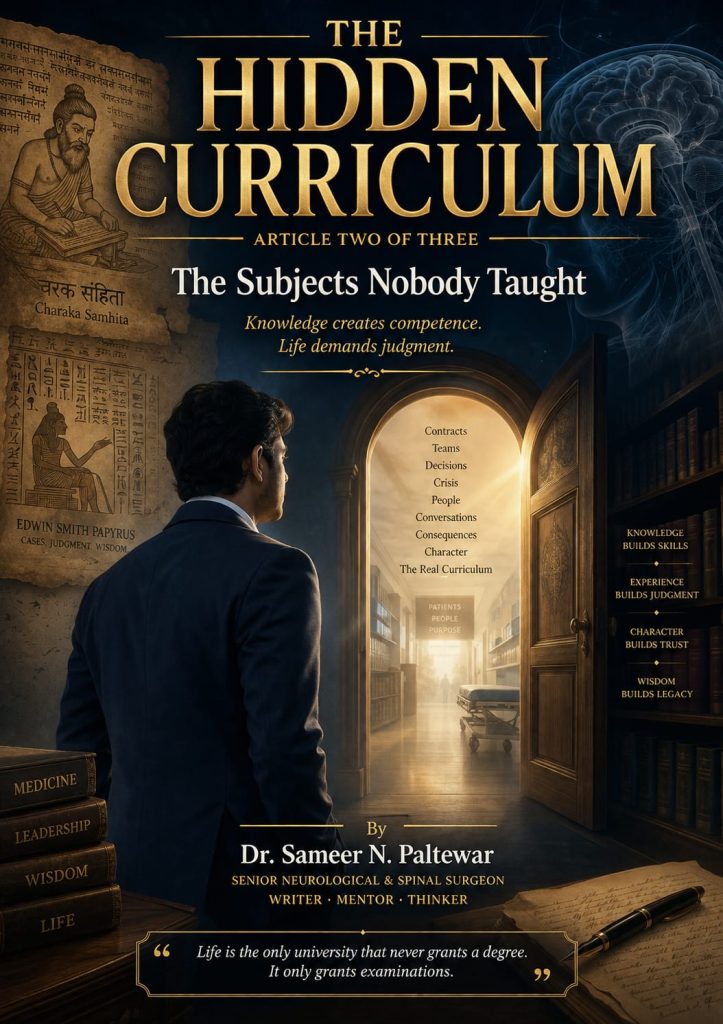
The Hidden Curriculum Article Two of Three
The Subjects Nobody Taught
Knowledge creates competence. Life demands judgment. And
judgment belongs to no single discipline.
The Door Education Never Mentioned
There is a moment in every professional life when a door opens that education never once described. It may arrive as a contract full of invisible traps. A team that needs leadership, not instruction. A camera pushed into your face outside an emergency ward. A grieving family searching your eyes for something no textbook ever printed. In that moment you understand something you were never told: your training taught you how to practise. It never taught you how to survive.
The irony is almost architectural. The deeper medicine travels into a single organ, the broader life becomes outside the consulting room. A neurosurgeon may spend twenty years mastering the anatomy of the brain, yet one poorly worded email can produce more damage than a technically difficult operation. Knowledge creates competence. Life demands judgment. And judgment, it turns out, belongs to no single discipline — a fact every great healing tradition on earth seems to have arrived at independently.
The Fourth Pillar of Ayurveda
Charaka, compiling the foundational text of Ayurveda somewhere in the early centuries of the common era, was unusually precise about what makes a physician complete. He named four pillars supporting any successful treatment: the physician, the patient, the attendant, and the medicine itself. But he did not stop at naming the physician as a pillar. He specified what qualified someone to actually be one — shastra jnana, theoretical knowledge; drishta karma, practical experience actually witnessed and performed; daksha, dexterity and skill of hand; and shuchi, cleanliness — a term that classical commentators expanded well beyond hygiene into something closer to integrity of conduct.
Notice the proportions. Only one of Charaka’s four qualifications concerns raw knowledge. The remaining three are judgment, skill under pressure, and character — precisely the subjects that sit outside any syllabus. Ayurveda’s oldest surviving text, composed roughly two thousand years before the phrase hidden curriculum was coined by a Western educational psychologist, had already built the concept directly into its definition of what a physician is. A healer who possessed shastra jnana but lacked shuchi was not considered a lesser doctor. He was not considered a complete one at all.
“Only one of Charaka’s four pillars’ concerns
raw knowledge. The other three are judgment,
skill under pressure, and character.”
The Scribe of the Wound
Four thousand years ago, in the workshops of ancient Egypt, a physician known to history only through the papyrus that survived him — now called the Edwin Smith Papyrus — recorded forty-eight case studies of trauma with a discipline that would not look out of place in a modern surgical logbook. Each case follows an identical structure: title, examination, diagnosis, and then, remarkably, one of three verdicts. An ailment I will treat. An ailment I will contend with. An ailment not to be treated.
That third verdict is the one worth sitting with. The Egyptian physician was trained, four millennia before the concept had any modern vocabulary, to recognise the boundary of his own competence and to say so in writing, permanently, where any colleague might later read it. This was not failure. It was the single most sophisticated judgment a healer of that age could offer — knowing precisely where treatment ended and honesty began. No scroll in any Egyptian medical school taught how to face a family and say this wound is beyond what I can mend. The scribe who wrote case forty-seven learned that lesson somewhere else entirely, the same place every physician since has learned it: at the bedside, without a professor in the room.
The Man Who Knew He Did Not Know
When the Oracle at Delphi declared Socrates the wisest man in Athens, he did not believe it, and he spent much of the remainder of his life trying to disprove it by questioning everyone the city considered wise — poets, craftsmen, statesmen. He discovered something that unsettled him more than it satisfied him. Each of these men possessed genuine, often extraordinary competence in a narrow craft. And nearly every one of them mistook that narrow competence for a broader wisdom they did not, in fact, possess.
Socrates concluded that his only advantage was a strange, almost embarrassing one: he, at least, knew that he did not know. The craftsman who could build a ship flawlessly assumed this also qualified him to advise the city on war and justice. It did not, and the gap between his craft and his judgment was invisible to him precisely because his craft was so genuinely excellent. Two and a half thousand years later, the same gap opens beneath surgeons who can separate conjoined twins yet cannot hold a team together through a crisis, and beneath physicians who can diagnose the rarest disease on the ward yet struggle to negotiate a fair contract in the office next door. Excellence in one dimension has never once guaranteed wisdom in the others. Socrates found the entire city forgetting this. Every profession forgets it anew, once a generation.
The Load-Bearing Walls
This is the hidden curriculum in full — the vast, unspoken syllabus every profession carries but no university dares to name on a certificate. How to recognise an unfair contract before signing it. How to build a team when you have never managed anyone in your life. How to read a balance sheet when your training only ever taught you to read a scan. How to handle a journalist when one wrong word can undo a decade of reputation. How to explain a complication to an angry family without deepening the wound already there.
These are not soft skills, a phrase that has always undersold what it describes. They are the load-bearing walls of a career. Remove them and the structure does not merely weaken — it eventually comes down, often quietly, often in a way that looks from the outside like a single sudden failure rather than what it actually was: years of untested wall finally meeting its first real load.
A Curriculum Always One Generation Behind
Why does this keep happening, century after century, tradition after tradition? Because education is always a generation behind reality. Medical schools were designed for a world where doctors worked inside hospitals, protected by institutions, judged only by their peers. Today’s doctor inhabits a considerably larger world — building organisations, leading multidisciplinary teams, navigating regulation, managing technology, responding to media, protecting a digital reputation that did not exist when the curriculum was written.
The syllabus has not kept pace with the profession. It still prepares clinicians with genuine and admirable rigour. But the world outside now examines entrepreneurs, leaders, communicators, and risk managers — all at once, in the same person, often within the same difficult week.
The Missing Subject
Perhaps the most important subject missing from every curriculum, in every tradition examined here, is the same one Charaka named shuchi and Socrates discovered by accident in the streets of Athens: humility. The humility to recognise that clinical excellence is the beginning of a career, never its end. That every profession eventually outgrows its own education. That the real teachers are rarely found in lecture halls — they are found in the contracts that betrayed you, the reviews that stung you, the teams that challenged you, and the failures that quietly educated you somewhere in the small hours of an ordinary morning.
Life is the only university that never grants a degree. It only grants examinations, and they arrive without warning, in the middle of an ordinary Tuesday, wearing the costume of a problem you were never formally trained to solve.
By
Dr. Sameer N. Paltewar
WRITER · MENTOR · THINKER