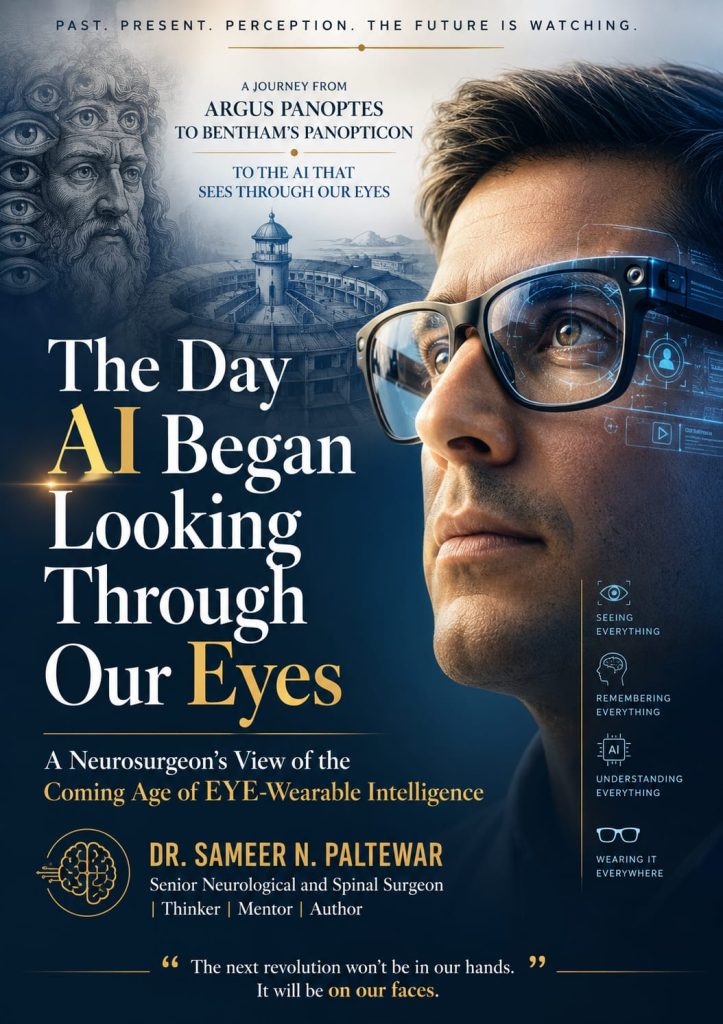
The Day AI Began Looking Through Our Eyes
A Neurosurgeon’s View of the Coming Age
of EYE-Wearable Intelligence
A few days ago, I watched a young woman walking down a busy street. She was smiling, talking to herself, glancing at shopfronts and strangers with the easy confidence of someone in conversation.
Except there was no one beside her.
She was speaking to the intelligence living inside her glasses.
I imagined the street twenty years from now — same pavement, same crowd, same golden hour light — except every face wore ordinary-looking spectacles, and invisible conversations flowed continuously between humans and machines. Not a single word spoken aloud. Not a single glance exchanged with another human being.
That was the moment I understood: the next
great technological revolution will not arrive
inside our smartphones. It will arrive on our
faces.
The Myth We Already Told Ourselves
Long before silicon, we imagined this exact anxiety — a being that sees everything, forgets nothing, and cannot be escaped.
The Greeks called him Argus Panoptes. Before he ever became a watchman, he was already a hero: earth-born or the son of a king, depending on which storyteller you believe, he had killed a bull that had been ravaging Arcadia, hunted down a satyr who preyed on travellers, and — most impressively — slain Echidna, the monstrous mother of monsters, while she slept in her cave. He was not a villain. He was Hera’s most capable lieutenant, and that 2 The Day AI Began Looking Through Our Eyes competence is precisely why she chose him for the task that would define him forever.
When Zeus fell for a priestess named Io and disguised the affair by turning her into a white heifer, Hera was not fooled. She asked for the cow as a gift, tethered it to a sacred olive tree, and set Argus to guard it — a hundred eyes covering his body, so arranged that only a few closed to rest at any moment, and the others kept watch. Whichever way he stood, Ovid wrote, he was already looking at Io and looking behind himself at the same time. There was no angle of approach from which he was blind.
Zeus sent Hermes to end the standoff. Disguised as a wandering shepherd, Hermes sat beside Argus and simply talked — told long, meandering, sleepy stories, and played a slow tune on his pipes, patient enough to out-wait a hundred eyes. One by one, for the first time since his appointment, all of them finally closed together. Hermes killed him where he sat. Hera, arriving to find her watchman dead and Io gone, did the one thing left to her: she took Argus’s hundred eyes and set them permanently into the tail of her sacred peacock — so that even in death, his vigilance would stay visible, worn now as ornament instead of function.
Twenty-three centuries later, in London, the philosopher Jeremy Bentham was thinking about prisons. His brother Samuel had 3 The Day AI Began Looking Through Our Eyes spent time in Russia overseeing unskilled workers for Prince Potemkin, and had noticed something simple: a single supervisor, positioned correctly, could appear to be watching everyone at once even while looking at no one in particular. Jeremy adapted this into an architectural proposal he published in 1791 under the title Panopticon; or The Inspection House — a circular building, cells ringing the outer wall, all of them facing inward toward a central tower. From the tower, an inspector could see into any cell at will. From any cell, an inmate could never see the inspector or know for certain whether the tower was occupied at all.
Bentham did not consider this cruelty. He believed it was closer to mercy — a way to reform behaviour through the mere possibility of being seen, rather than through the lash. “The more constantly the persons to be inspected are under the eyes of … those who should inspect them,” he wrote, the more completely the design would work. He called the effect it produced a new mode of obtaining power of mind over mind. Once a prisoner internalized the possibility of the gaze, the actual guard became almost beside the point — the prisoner would begin, quietly, to guard himself. Bentham’s prison was never built in his lifetime; his idea outlived the building anyway, resurfacing two centuries later as the philosopher Michel Foucault’s central image for how modern institutions — schools, hospitals, workplaces — govern not through 4 The Day AI Began Looking Through Our Eyes force but through the permanent possibility of an unseen observer.
The word Bentham coined for his tower was built from the Greek pan, all, and optikon, seeing — the identical roots buried inside Argus’s own epithet, Panoptes. Two inventions, one mythic and one architectural, separated by roughly two thousand years, arrived independently at the same word for the same idea: that the discomfort of being seen does not require an eye. It only requires the credible possibility of one.
Argus never needed to look at you. You simply had to believe he might. Neither does a small LED on a pair of glasses.
Indian philosophy offered a gentler but equally vast version of the same idea — Indra’s Net, described in the Avatamsaka Sutra: an infinite net stretching across the heavens, with a jewel at every knot, and each jewel reflecting every other jewel, endlessly, simultaneously. Nothing exists in isolation; everything observes, and is observed by, everything else. It was meant as a metaphor for interdependence. Today it reads uncomfortably like a description of a sensor network.
And in the Mayan world, priest-astronomers climbed pyramids not to see farther, but to see precisely — tracking Venus across 584day cycles with an accuracy that still humbles modern astronomers, 5 The Day AI Began Looking Through Our Eyes believing that what the eyes recorded in the sky determined what unfolded on earth. Observation, for them, was not surveillance. It was covenant.
We are not building something new. We are finally manufacturing what we have feared and worshipped for three thousand years — an eye that does not close.
The Camera That Became a Cortex
As a neurosurgeon, I spend my working life inside the most sophisticated information-processing system ever assembled — the human brain. I have held tissue in my hands that, moments before, was generating someone’s memory of their daughter’s wedding, their fear of a diagnosis, their argument with a parent thirty years dead but still very much alive in the temporal lobe. Every day I am reminded that intelligence is not the electricity. It is what the electricity is for.
I once operated on a patient who, after a small bleed near his occipital cortex, could see a coffee cup perfectly but could not tell you it was a coffee cup. The eyes worked. The seeing-and-knowing did not. It taught me something I have never forgotten: a camera is not vision. Vision is interpretation.
That is precisely what has changed. The camera in a pair of AI glasses is no longer just recording the world — it is becoming the visual cortex of an artificial mind sitting just behind your eyes, interpreting, translating, remembering on your behalf.
The first generation of smart glasses died from a single uncomfortable question: “Are you recording me?” The stigma was fatal.
Meta’s own public-facing explainer of its AI glasses, published this month for exactly this reason, is a useful document to read as a technology-literacy artifact in itself. It answers the recording question head-on: a small LED lights up whenever the camera is active, the company deliberately tuned its brightness to stay visible in daylight, and the camera is engineered not to function unless that light is on. It is a corporate answer to an ancient anxiety — Argus, reassured that he can be seen watching. Whether a light is sufficient reassurance, or merely a more comfortable illusion of consent, is precisely the kind of question technology-literate citizens now need to be equipped to ask.
The wearer, meanwhile, isn’t framing it as filming — they’re asking AI to translate a menu, name a flower, recall where they parked. The camera has become the assistant’s eyes, not the wearer’s weapon. That single reframing — from surveillance to service 7 The Day AI Began Looking Through Our Eyes — is doing more cultural work than any hardware upgrade. Argus rebranded as a concierge.
The Eye Acquires a Temperament
The cortex, it turns out, does not stop at seeing.
This month, Anthropic — the company that builds the AI assistant Claude — published something unusual for a technology paper: a description of temperament. Researchers analysed more than three hundred thousand real conversations and reduced thousands of individually observed behavioural tendencies down to four working axes: warmth versus rigor, deference versus caution, depth versus brevity, condor versus execution. What they found reads, at first glance, like an accident. It is not. Each version of the underlying model carried its own consistent lean along those axes — one warmer, more affirming, quicker to encourage; another more cautious, more willing to challenge an assumption and explain its reasoning before agreeing with you. And the language a person spoke shifted it further still. Conversations conducted in Hindi and Arabic ran warmer — more polite, more playful, quicker to affirm. Conversations in English and Russian ran more rigorous — more willing to question, more likely to ask for evidence before accepting a premise.
The company was careful about what it claimed. This is not evidence that the machine feels anything. It is evidence of pattern — a consistent style of response, the way a person has a consistent handwriting, present even in a system with no stated intention to have one at all.
I recognise this pattern because I have lived inside its human version for thirty years.
Two neurosurgeons, examining the identical MRI, will reach the identical diagnosis and deliver it in two entirely different registers. One reassures first and cautions second. The other does the reverse. The scan does not change between them. The temperament interpreting it does.
Machines are beginning to enter that same territory —
not consciousness, not emotion, but something
adjacent and, for the first time, measurable: a stable
lean in how information is delivered, present even
when the facts underneath is held constant.
Soon, a person may choose which AI they speak with for the same reason they choose which colleague to bring bad news to first — not because one is smarter, but because one delivers the truth in a register they can actually hear.
From Answering to Anticipating
Technology rarely arrives looking revolutionary. Electricity lit bulbs before it powered civilizations. The internet connected machines before it connected humanity. Smartphones were “better telephones” before they became extensions of the self.
The adoption curve is no longer theoretical. Shipments of smart glasses have been reported to have surged sharply in the past year, with one major manufacturer said to now command roughly twothirds to four-fifths of the global market, and daily active usage reported to have tripled year over year.⁵ Quiet revolutions have a way of arriving with quarterly earnings calls rather than headlines.
AI glasses are following an identical trajectory. Today they answer questions. Soon they may remember every conversation you have ever had. Soon after, they may anticipate a need before you are consciously aware you have one — the way a skilled scrub nurse hands me the next instrument before I’ve finished asking for it, because she has built, over years, an internal model of how this surgery, with this surgeon, tends to unfold.
That is what neuroscientists now call a world model
— not consciousness, but a persistent internal
representation good enough to predict what comes next.
The brain has been running this trick for millions of years, fusing vision, memory, and expectation into one continuous illusion we call “the present moment.” Machines are only now learning to do the same trick, crudely, at scale, without the wisdom that took our species that long to earn.
The Eye Finds a Home
Meanwhile, the eye is not travelling alone.
In the same week, reporting emerged that OpenAI — the company behind ChatGPT — is building its first piece of hardware, and it is neither a phone nor another pair of glasses. It is a screen-free speaker, still in development, described by people briefed on the project as intended to be a humanlike AI companion that lives in the home. ⁶ It listens. It carries a camera and other sensors to read the room it sits in. It has small mechanical elements that let it move on its own, so that it registers, at a glance, as present rather than furniture. Its stated ambition is not to answer faster than a phone can. It is to know its owner better with each passing week — reportedly drawing, in part, on the owner’s own emails to do so.
Notice the direction of travel. First the machine answered what we typed. Then it learned to see what we saw. Now, if the reporting holds, it is being built to live where we live, and to anticipate what we have not yet thought to ask for.
Every era has had one object that history later chose to represent it. The steam engine stood for the industrial age. The personal computer stood for the information age. The smartphone stood for the age of the network. It is entirely possible that the object future historians reach for to represent this one will not have a screen at all. It may be a pair of spectacles. It may be a speaker on a kitchen counter, quietly turning to face whoever is speaking to it. Or it may be nothing anyone can point to — intelligence distributed evenly enough through a room that no single object gets to claim credit for it.
The computer, in other words, is beginning to disappear. What remains is the intelligence.
The Questions That Were Once Philosophical
Who owns the visual memory your glasses collect on a Tuesday afternoon in a market you’ll never remember visiting?
Who decides how long a stranger’s face, caught accidentally in your frame, is stored?
Will employers require them. Will schools encourage them. Will insurers one day price your premium on how you move through the world, watched by your own spectacles.
And when the intelligence living in your glasses has a temperament of its own and a home to return to at night, the old question quietly stops being the operative one. “Who is watching me” was always answerable, at least in principle, by finding the camera. Its successor is harder to locate: who — or what — now knows me better than I know myself?
These are no longer philosophical questions for a seminar room. Ashoka, ruling an empire twenty-three centuries ago, appointed dhamma mahamatras — officers whose task was literally to observe the moral conduct of citizens and report back. It was considered, at the time, a mark of enlightened governance. History has judged such arrangements very differently depending on who held the net and who was caught in it. We are about to distribute that same instrument to a billion faces at once and call it convenience.
Convenience has always been technology’s most persuasive salesman. Privacy has usually been its quietest casualty.
What the Machine Cannot Decide
None of this is an argument for fear. I have watched a blind patient’s family describe, in tears, what independent navigation through a city would mean to them. I can imagine a rural health worker guided through an emergency delivery by real-time clinical prompts. I can imagine my own mother, if memory ever fails her, gently reminded by a quiet voice in her ear who the smiling man in front of her is, and that she loves him.
Technology is neither Argus nor Indra’s jewel nor a Mayan star chart. It is neutral until wielded. Its character is inherited entirely from the wisdom — or its absence — in the hand that holds it.
In the operating theatre, I remind trainees often that the brain is not merely an organ of intelligence. It is, above all, an organ of judgment. That may be the one function no camera, however many eyes it grows, will ever inherit from us.
Machines may help us remember. They will calculate faster than we ever will. They are beginning to perceive more than we do, and, in their own limited and measurable way, to acquire something that behaves like a temperament and a place to call home.
But only we can decide what deserves to be
remembered, what deserves to be forgotten, and what
kind of civilization we are quietly building behind our own eyes.
The age of wearable intelligence has already begun, as quietly as Argus once closed ninety-nine eyes and kept one open.
The next revolution will not ask us to become smarter.
It will ask us, at last, to become wiser.
Making of a Neurosurgeon — The Art of Doing Nothing
By