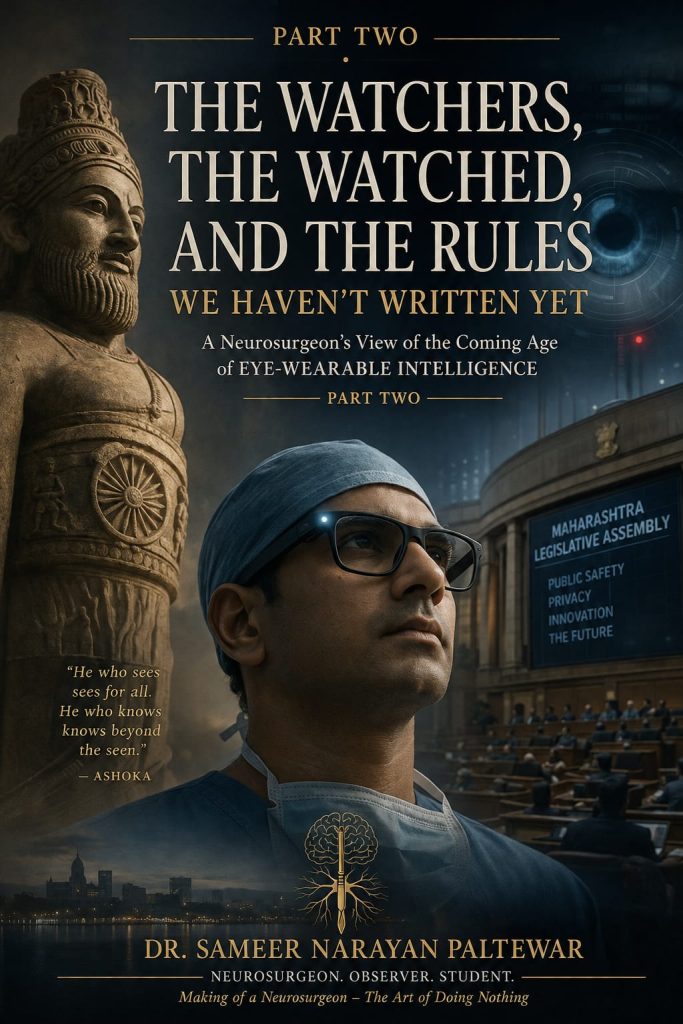
The Watchers, the Watched, and the Rules We Haven’t Written Yet
A Neurosurgeon’s View of the Coming Age of EYE-Wearable Intelligence — Part Two
It has already begun twenty minutes from where I operate
In June, legislators in the Maharashtra Legislative Assembly raised an alarm that would have sounded, a decade ago, like science fiction: AI-powered smart glasses, they warned, can secretly record audio and video and identify strangers by face while looking, to everyone around them, like an ordinary pair of spectacles. Lawmakers named the places that worried them most — government offices, police stations, courts, hospitals, schools, temples — and flagged risks to women’s safety, to minors, to medical confidentiality, to the security of sensitive government information. The state has now ordered an expert committee to study the technology and draft rules within four months. ¹
Argus, it turns out, is already sitting in the visitors’ gallery.
The myth was never really about a giant. It was about
the discomfort of not knowing who is watching, and
what they intend to do with what they see. That
discomfort has just acquired a legislative committee.
The Questions That Were Once Philosophical
Who owns the visual memory your glasses collect on a Tuesday afternoon in a market you’ll never remember visiting? That question stopped being hypothetical this year. Swedish journalists reported that footage captured by consumer AI glasses — including intimate and private moments — had been routed to outsourced human contractors, working from offices in Kenya, whose task was to label the material for AI training. The revelations triggered a class-action lawsuit in the United States and formal questions from members of the European Parliament.²
Who decides whether a stranger’s face, caught accidentally in your frame, can be identified? Reporting this year described an internal company memo for a feature that would let AI glasses recognize people in real time and surface their names — pitched internally, in part, as useful for blind and low-vision users, and drafted with an awareness that the political climate might leave less attention for critics to spare.³ In Illinois, the same underlying capability has already cost one company more than two billion dollars in settlements over biometric data collected without consent, under a state law that has become the most consequential biometric statute in the country.⁴
Will governments regulate, or merely relocate, the problem? Europe has drawn its line furthest forward: the EU AI Act prohibits, outright, the use of AI systems for real-time remote biometric identification of people in public places. A Pennsylvania lawmaker has proposed requiring smart glasses to carry a recording indicator that a wearer cannot switch off — responding to reports that a market already exists for disabling the very LED lights meant to reassure bystanders.⁵ India’s own Digital Personal Data Protection Act and its 2025 rules now classify facial data as sensitive personal information requiring specific, unbundled consent — a meaningful standard on paper, and, as with Ashoka’s inspectors twenty-three centuries earlier, only as good as the will to enforce it in practice.⁶
These are no longer questions for a seminar room. They are questions with docket numbers, committee deadlines, and, in Nagpur’s own state assembly, a four-month clock already running.
The Light That Isn’t Enough
In Part One, I described the small LED that lights up on a pair of AI glasses when the camera is active — a modern, miniature answer to Bentham’s inspection tower, a visible signal meant to convert the old anxiety about hidden surveillance into something a bystander could see and trust.
It has not entirely worked. Ireland’s data protection authority raised concerns as early as 2021 that no evidence had been offered showing the light actually succeeds at notifying the people being recorded, rather than simply existing as a design gesture.⁷ More recently, reporting has described a small but growing market for devices and modifications that disable the indicator altogether — for the wearer who would prefer that Argus’s one open eye stay shut.⁸ Meanwhile, a segment of manufacturers has begun marketing camera-free smart glasses as the more honest alternative: no image sensor, no recording capability, no LED required, because there is nothing left for it to warn you about.⁹
Bentham’s insight was that the discomfort of being watched does not require an eye — only the credible possibility of one. What the last two years have shown is the mirror image of that insight: reassurance does not require an eye either. It only requires the credible appearance of transparency, whether or not the transparency is real. A light that can be switched off is not a tower. It is a suggestion.
What the Machine Cannot Decide
None of this is an argument for fear, any more than it was in Part One. I still believe in the blind patient navigating a city independently, the rural health worker guided through an emergency delivery, the elderly patient gently reminded who the smiling man in front of her is. Regulation exists to make room for exactly those uses while closing the door on the others — which is a harder engineering problem than any camera or chip.
In the operating theatre, judgment is the thing we spend a decade training and can never fully hand off. A resident can learn the anatomy in a year and the decision-making in ten, because the decision-making is not a lookup table — it is knowing when the textbook case in front of you is quietly not a textbook case at all. I have stood over patients where every scan said one thing and something else, some accumulated and unnamable instinct, said to wait, or to change course, or to call for a second opinion I couldn’t fully justify on paper. That instinct is not mystical. It is judgment, built from thousands of prior observations the conscious mind no longer has to replay one by one. It is also, I suspect, the last function any camera will ever manage to copy, however many eyes it grows and however well it predicts what I am about to ask for next.
There is an older Indian idea that belongs at the end of this essay rather than the beginning — the Vedantic notion of the sakshi, the witness. Classical Indian philosophy held that the truest observer in any of us is not the eye, or the mind that interprets what the eye sees, but a quieter awareness behind both, one that watches the watching itself without needing to record or judge or intervene. It asks for no LED. It cannot be subpoenaed, hacked, or sold to a data broker. It is, in a sense, the one camera we were each issued at birth that never needed a committee to regulate it, because it was never capable of looking anywhere but inward.
Machines are now building an external eye good
enough to rival Argus. Perhaps the only adequate
response is to get reacquainted with the internal one.
The age of wearable intelligence has already reached a legislative committee in Nagpur, a courtroom in Illinois, and a regulator’s desk in Brussels. The rules are still being written, in real time, by people who are learning the shape of the problem as they go — much as Bentham’s own prison was debated for two decades before anyone admitted it might never be built the way he imagined it.
The next revolution will not ask us to become smarter. It will ask us, still, to become wiser — and this time, it is asking the legislatures too.
Making of a Neurosurgeon – The Art of Doing Nothing
By
Dr. Sameer Narayan Paltewar