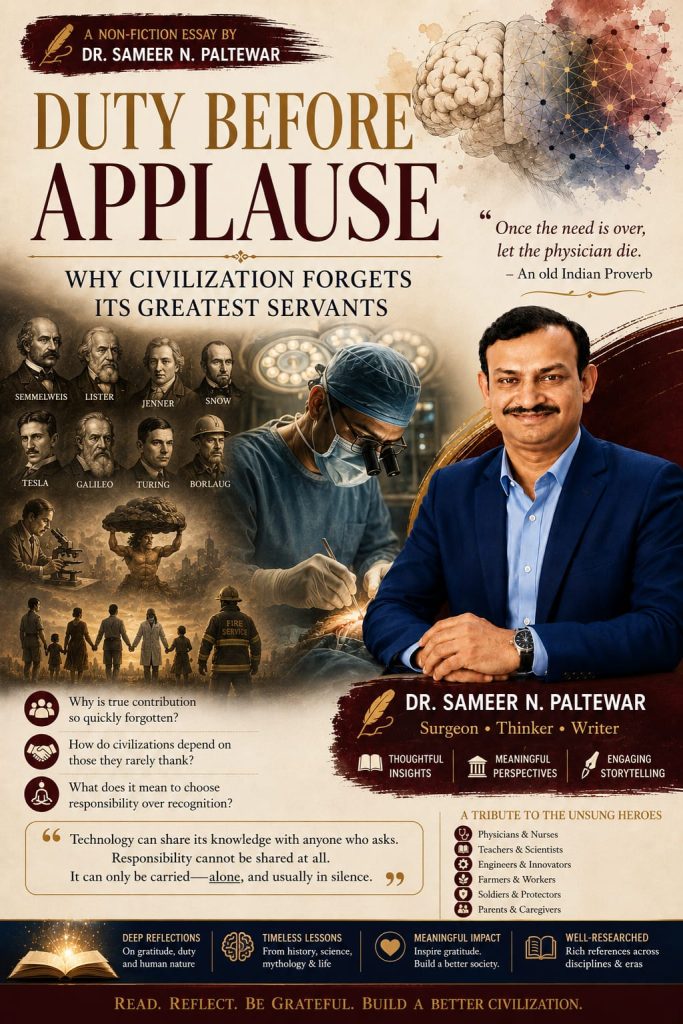
Duty Before Applause – Why Civilization Forgets Its Greatest Servants
The Paradox of Gratitude
There is an old Indian proverb that has survived for centuries, repeated in villages long after anyone remembers who first said it.
गरज सरो, वैद्य मरो.
Once the need is over, let the physician die.
It sounds cruel — almost vengeful. But like most proverbs that refuse to die, it isn’t really about physicians at all. It is about us. It names one of civilization’s oldest and most uncomfortable habits: we depend most on the people we notice least.
We applaud the rescue and forget the rehearsal. We celebrate the miracle and erase the decade of failure that made it possible. Gratitude, it turns out, has a shelf life — and that shelf life is exactly as long as our need.
Perhaps that is the oldest flaw we carry.
“Once the need is over, let the physician die.
” The cruelty in that proverb was never really
about doctors. It was a mirror.”
When Success Becomes Invisible
Every morning, a switch is flicked and a room fills with light — and no one in that room thinks of the men who first tamed electricity. Water runs clean from a tap, and no one silently thanks the engineer who designed the plant three towns away. We cross bridges assuming they will hold. We board aircraft assuming they will land. We walk into operating theatres assuming we will walk back out.
This is the strange tax that competence pays. The better a profession becomes at its work, the less that work is seen.
Reliability is its own disappearing act.
The Loneliness of Responsibility
No profession understands this arithmetic better than medicine.
When a patient survives a difficult operation, the family says, simply, the surgery was successful. The sentence has no subject. Success, somehow, belongs to everyone — the hospital, the medicines, luck, prayer, the universe’s general goodwill.
When the patient dies, the sentence changes its shape entirely.
What did the surgeon do?
Failure always finds an address. Success rarely does.
Every surgeon who walks into an operating theatre carries something heavier than the instruments laid out on the tray. Every incision is a bet placed under uncertainty. All decision balances hope against risk, and every complication leaves two wounds — one in the patient’s body, one that the surgeon carries home and tells no one about.
Hippocrates wrote it down twenty-four centuries ago, and no one has improved on it since: life is short, the art long, opportunity fleeting, experience deceptive, judgment difficult. Long before that, the Code of Hammurabi was blunter still — if a surgeon’s hand caused the death of a nobleman, that hand would be cut off.
The punishments have softened. The weight has not moved an inch.
“Success belongs to everyone. Failure belongs
to one person, standing alone in a room,
replaying every decision at three in the morning.”
Civilization’s Forgotten Visionaries
Medicine is only one chapter of a much older story — and history keeps telling it the same way.
First, the world laughs. Then it resists. Then, quietly and without apology, it depends. And finally, having absorbed the gift so completely that it forgets a gift was ever given, it simply forgets the giver.
Ignaz Semmelweis was mocked, then institutionalised, for the crime of asking doctors to wash their hands. Joseph Lister was ridiculed for insisting that surgeons not operate in coats stiffened with the blood of previous patients. Edward Jenner was caricatured in the press, drawn with cattle hornssprouting from his patients’ heads, for daring to suggest that cowpox could prevent smallpox. Barry Marshall, unable to convince a sceptical profession any other way, drank a glass of bacteria himself and gave himself an ulcer to prove his point. John Snow pulled the handle off a pump on Broad Street and changed the course of public health forever — and died before most of his colleagues admitted he had been right.
Step outside medicine and the pattern barely changes its costume. Galileo was made to kneel and recant what his own telescope had shown him. Nikola Tesla imagined a world wired with electricity that almost no one around him believed possible. Alan Turing helped break the code that arguably won a war and was chemically punished by the country he saved. Norman Borlaug’s seeds kept more than a billion people from starving, and most of those billion will go their whole lives without learning his name.
Civilization has a genius for normalising yesterday’s miracle by sunset and forgetting yesterday’s miracle-worker by midnight.
The Heroes Hidden in Plain Sight
Our mythology understood this before psychology gave it a name.
Every child in India can tell you about Hanuman lifting an entire mountain into the sky because he could not find the Sanjeevani herb growing on it in the dark. Far fewer remember Sushena Vaidya — the physician on the battlefield who looked at the dying Lakshmana, understood exactly what was wrong, and knew precisely which herb, on which mountain, would save him.
Strength became legend. The knowledge that gave the strength its purpose quietly slipped out of the story.
It happens everywhere, not only in epics. Teachers shape the inner architecture of children they will lose touch within a decade. Scientists spend entire careers on discoveries whose beneficiaries will never learn their names. Farmers rise in pitch darkness so that cities three hundred kilometres away can complain about the price of onions instead of the absence of them. Firefighters run into the one building everyone else is running out of. Soldiers stand awake through freezing nights so that strangers, warm in their beds, never have to think about the cold at all. Parents fold their own unlived dreams into small, neat packages and hand them to their children without comment.
The finest work a society produces tends to vanish from sightfor the simple, infuriating reason that it succeeded.
“Hanuman lifted the mountain. Sushena
Vaidya knew which herb on it would save a life.
One became legend. The other became a footnote.
That is the whole pattern of human memory, in one verse.”
The Psychology of Forgetting
Psychologists have a clinical name for it: hedonic adaptation. Economists call it normalisation. The label changes; the mechanism does not.
We adjust to what works with frightening speed. Electricity. Vaccines. Clean water. Anaesthesia. A surgeon who has never lost a patient to infection. A teacher who never once failed to show up. A peace so complete that an entire generation forgets war was ever a daily possibility.
We notice all of these only in the instant they fail.
The more dependable a person becomes, the more completely they disappear into the background of our lives — and the less we are able to see the years of discipline holding that background steady.
Reliability, quietly and without anyone intending it, erases recognition.
Duty Before Applause
Artificial intelligence may soon read scans faster than any radiologist alive. Robotic arms may make incisions steadier than any human hand has ever managed. Algorithms may catch a cancer eleven months before a doctor would have found it.
One responsibility, even then, will remain stubbornly, irreducibly human.
Moral responsibility.
No machine has ever sat beside grieving parents in a hospital corridor at two in the morning, searching for words that do not exist. No algorithm has lain awake replaying a complication that no textbook predicted, asking itself the one question that has no clean answer: could I have done this differently?
Technology can share its knowledge freely, instantly, with anyone who asks. Responsibility cannot be shared at all. It can only be carried.
Perhaps the truest measure of a civilisation is not how loudly it applauds its triumphs. It is how faithfully it remembers the people who built those triumphs in silence, expecting nothing back.
The physician. The nurse. The teacher. The scientist. The engineer. The farmer. The firefighter. The sanitation worker who keeps a city from drowning in its own waste. The soldier. The parent.
They belong to the same quiet fraternity, scattered across every profession and every country, united by nothing but a single, unfashionable instinct: duty before recognition, responsibility before comfort, service before applause.
“Technology can share its knowledge with
anyone who asks. Responsibility cannot be
shared at all. It can only be carried — alone,
and usually in silence.”
The Civilization Behind Every Miracle
Every successful operation that happens today rests on a pyramid of forgotten sacrifice. Anatomists who dissected bodies in secret, sometimes risking their own lives to understand ours. Physicians who were laughed out of conference halls for challenging the dogma of their century. Engineers who built the first operating microscope, allowing human hands to work on vessels no wider than a thread. Chemists who discovered that pain itself could be switched off, briefly, mercifully, for the first time in the history of the species. Microbiologists who turned infection from a death sentence into a footnote. And now, somewhere in a room we will never see, programmers writing the code that will quietly assist the surgeons of the next generation.
Every single life saved is a collaboration that spans centuries between people who will never meet.
Gratitude, then, should probably not stop at the doctor standing beside the bed. It should reach further back — to the long, mostly nameless civilisation standing quietly behind him, the one that handed him everything he knows before he ever picked up an instrument.
History keeps offering the same lesson, in different costumes, century after century, and we keep needing to relearn it.
Civilizations are not built by those who receive the loudest applause.
They are built, brick by invisible brick, by those who quietly choose duty before applause.