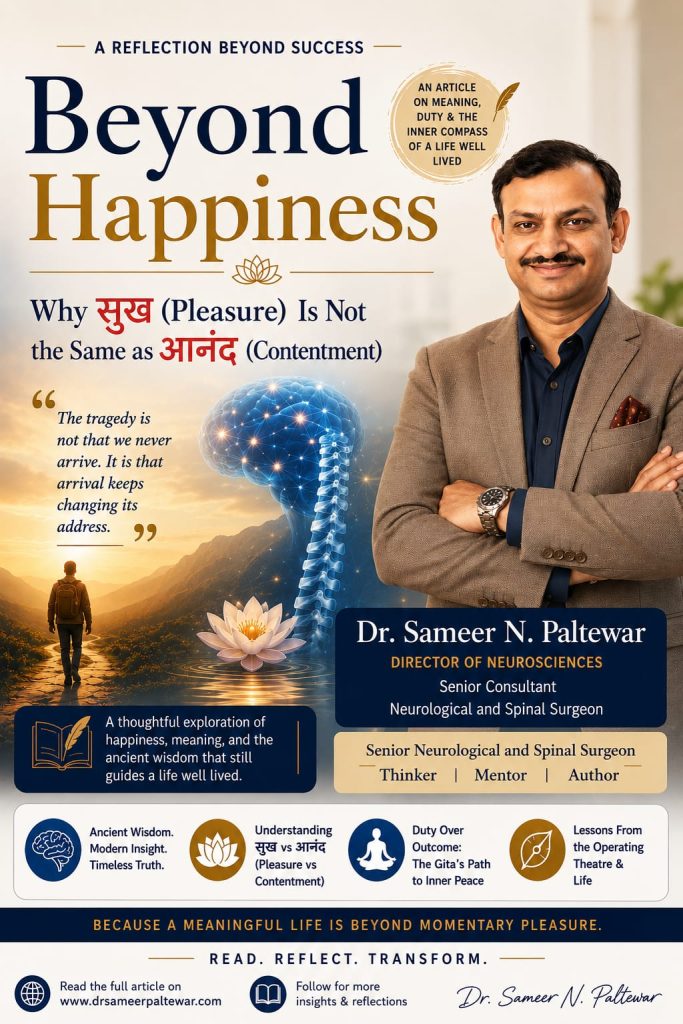
Beyond Happiness – Why सुख (Pleasure) Is Not the Same as आनंद (Contentment)
The Wrong Question
People often ask me which operation gave me the greatest happiness. I understand why they ask it. Brain surgery carries a certain mythology — the drama of life and death compressed into a theatre of light and instruments. But it is the wrong question, and I know this because I have lived through its answer.
My first successful brain surgery was unforgettable. Until the second. Then the hundredth. Nothing had changed in the operating theatre — the smell of antiseptic, the hush of concentrated attention, the extraordinary intimacy of holding a human brain in one’s care. But something had changed in me. What once felt extraordinary had quietly become ordinary. What began as a miracle had evolved into a morning.
Psychologists call this hedonic adaptation — our remarkable ability to become accustomed to life’s greatest pleasures. The new car loses its shine. The promotion becomes yesterday’s news. The dream, once realised, stops feeling like a dream. We spend our lives walking toward a horizon that keeps retreating, not because we are failing, but because the brain was designed this way. Success doesn’t merely raise our expectations. It silently resets them.
“The tragedy is not that we never arrive. It is
that arrival keeps changing its address.”
The Burden of Being Extraordinary
But hedonic adaptation is only part of the problem. The deeper wound is cultural. Somewhere in the last few decades, modern society quietly redefined what a successful life looks like — and the new definition is exhausting.
For most of human history, being an honest teacher, a devoted parent, a skilled craftsman or a respected physician was considered a life well lived. Ordinary competence, faithfully applied, was its own dignity. That understanding has eroded. Today we are expected not merely to succeed, but to become exceptional — not merely educated, but world-class; not merely respected, but visible; not merely accomplished, but influential. The village square, where we once compared ourselves with neighbours we actually knew, has been replaced by social media, where we compare ourselves with billionaires’ best moments and celebrities’ curated highlights. The result is entirely predictable. Average begins to feel like failure. Contentment begins to feel like complacency. Rest begins to feel like falling behind.
No civilisation in history has ever demanded this level of relentless self-comparison from this many people simultaneously. We are not competing with reality. We are competing with everyone else’s best day — endlessly, in real time, at scale. And the scoreboard never resets.
What the Scriptures Already Knew
Long before psychology named this affliction, Indian philosophy had already mapped its terrain — and offered a way out.
Our scriptures make a distinction that English collapses into a single inadequate word. सुख and आनंद are not synonyms. सुख is pleasure dependent on circumstances, on praise and possessions, on outcomes turning in our favour. It is real, but it is fragile. It lives and dies with the conditions that produce it. आनंद is something altogether different. It grows from purpose, from character, from कर्तव्य – from the fulfilment of one’s duty without clutching at its rewards. One depends on what happens to us. The other depends on who we are becoming.
The Bhagavad Gita expresses this through निष्काम कर्म: act -without attachment to the fruit of action. The paradox is elegant and ancient – happiness pursued directly tends to flee; meaning pursued through duty quietly becomes happiness. Centuries later, on another continent, Aristotle arrived at the same conclusion. He called it eudaimonia – not a pleasant life, but a life well lived, a life that fulfilled its own deepest purpose. Different civilisations, different languages, the same enduring truth: pleasure is what we feel, meaning is what we are.
“सुख is what happens to us. आनंद is what we become.
One is weather. The other is character.”
What the Operating Theatre Taught Me
Medicine confirmed this more viscerally than any philosophy textbook ever could. The most meaningful days of my career have rarely been the most pleasant. Fourteen-hour operations. Sleepless nights. Decisions made in darkness where no protocol reaches. Conversations that no doctor ever wishes to have, and that no training quite prepares you for. There is little सुख in those moments. And yet they remain among the richest of my life — not because they were pleasurable, but because they mattered completely. The deepest satisfaction I have known has arrived not in the moments of success, but in the moments of full, undivided responsibility.
The same pattern holds everywhere beyond the operating theatre. Raising a child through illness. Caring for a parent who no longer remembers your name. Teaching a struggling student through the same material for the fourth time. Building something that might fail. Serving in ways that go unrecognised. None of these are consistently enjoyable. All of them are profoundly meaningful. The finest lives I have encountered are rarely the most comfortable. They are simply the most worthwhile.
Ordinary Lives Hold the World Together
History celebrates extraordinary people. Civilisations are sustained by ordinary ones. The teachers who shape minds without ever making headlines. The parents who sacrifice quietly and without applause. The nurses who hold a stranger’s hand at three in the morning. The farmers who rise before the city wakes so the city can eat. The scientists who spend decades solving problems they may never receive credit for. Most of humanity’s genuine progress rests not on spectacular breakthroughs, but on millions of unremarkable acts of competence and care, repeated faithfully every single day.
The sky is not held up by its brightest star. It is held together by the vast and invisible weight of everything else.
The AI Age’s Greatest Temptation
All of which makes this particular historical moment unusually dangerous.
Artificial intelligence is becoming extraordinarily efficient at one thing above all others: maximising pleasure. It learns what you like to watch before you know it yourself. It curates your feed, anticipates your preferences, smooths your friction, and delivers the next reward before the last one has fully faded. Every notification is a small dopamine calculation. Every algorithm is a machine learning to keep you comfortable. The technology is genuinely impressive. The cost, quietly accumulating beneath the surface, is something else entirely.
Pleasure is not purpose. Entertainment is not fulfilment. Comfort is not a life. The greatest danger of the AI age is not that machines become too intelligent. It is that humans become too entertained — endlessly stimulated, effortlessly distracted, and slowly, without noticing, forgetting the particular satisfaction that comes only from doing something difficult and necessary and real.
“The greatest risk of the AI age is not that
machines become too intelligent. It is that
humans become too comfortable to care.”
What Remains When Everything Else Fades
After thousands of hours in the operating theatre, I have arrived at a belief that surprised me when it first arrived and has not weakened since. The measure of a life is not how much happiness it accumulates, but how much meaning it leaves behind. Awards gather dust. Applause fades. Fame is absorbed by the next news cycle. What remains is quieter and more durable than any of these: a life improved, a family held together through the worst of it, a student who found her path, a promise kept when breaking it would have been easier, a duty fulfilled without anyone watching.
This is what both Shri Krishna Bhagwan and Aristotle were pointing toward, across their centuries and their cultures. Not the abolition of pleasure — pleasure is real and beautiful and worth having. But the recognition that pleasure, pursued as an end in itself, leads us in circles. Meaning, pursued through duty and contribution and care, leads somewhere worth going.
Pleasure becomes a Memory. Meaning becomes Character.
And Character — far more than happiness, far more than success, far more than the approval of any algorithm — is what ultimately defines a life.
By
Dr. Sameer N. Paltewar (पालतेवार)
WRITER · MENTOR · THINKER