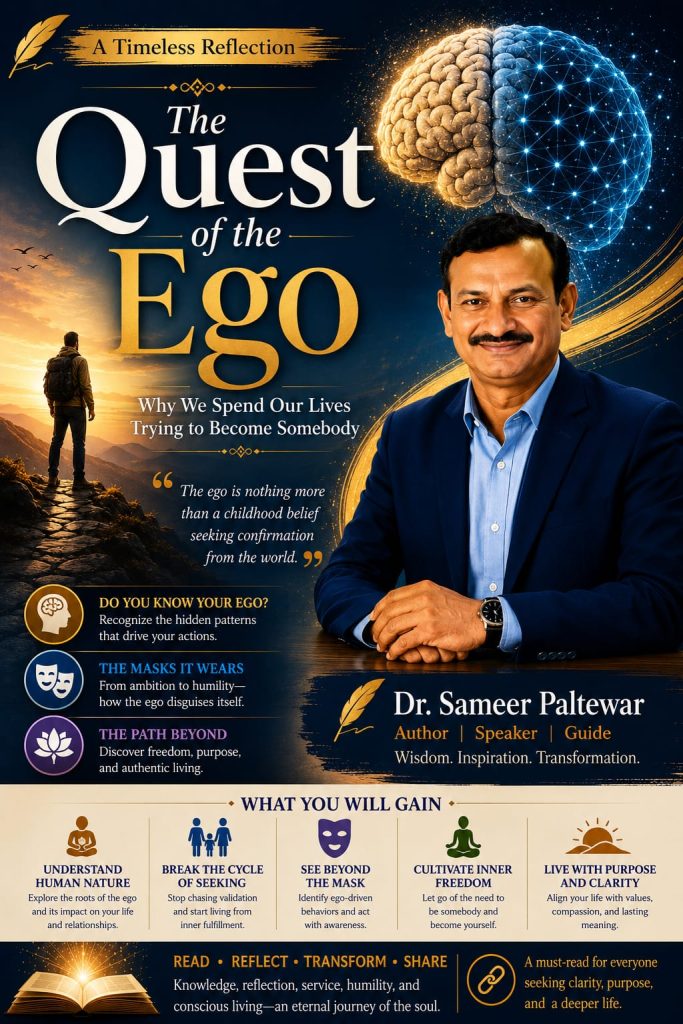
The Quest of the Ego – Why We Spend Our Lives Trying to Become Somebody
The Paradox of Human Birth
Among all living creatures, human beings begin life with a remarkable disadvantage. A newborn foal struggles to its feet within an hour of birth. A calf instinctively searches for its mother’s milk. Sea turtles, having never seen their parents, crawl instinctively toward the ocean. Many birds hatch with behaviours already encoded into their nervous systems. Nature equips most species with the tools necessary for survival almost immediately.
The human child, by contrast, arrives astonishingly incomplete. For months it cannot even hold up its own head. It cannot walk, feed itself, regulate its own body temperature, protect itself, or survive even a single day without another human being. Compared with almost every other mammal, a human infant appears to be nature’s least successful design. At first glance, this seems like evolution’s greatest mistake. Yet, in reality, it may be evolution’s greatest masterpiece.
Human helplessness is not a flaw; it is the foundation upon which civilization itself was built. Because the infant cannot survive alone, parents remain together longer. Families emerge. Grandparents become indispensable. Communities develop. Language evolves. Teaching becomes essential. Knowledge accumulates from one generation to the next instead of disappearing with each lifetime. Our greatest weakness became our greatest evolutionary strength. Without prolonged childhood, there would have been no schools, no traditions, no literature, no science, and perhaps no civilization itself. Ironically, everything we celebrate as uniquely human began with absolute dependence.
The Birth of the Ego
Yet every evolutionary gift carries an unintended consequence. Imagine the world through the eyes of a sixmonth-old baby. The child feels hunger and cries. Within moments someone appears with food. The child feels cold, and someone wraps it in a blanket. It feels frightened and immediately loving arms lift it into safety. Every discomfort summons a response. Every need appears to command the world.
The infant has no understanding that the mother has her own thoughts, exhaustion, dreams, anxieties, or responsibilities. To the infant, reality behaves almost like magic. Desire appears, and the world rearranges itself. Without any conscious decision, the child’s brain constructs its very first model of reality: I am the center. Everything exists for me.
This belief is not arrogance. It is simply a necessary stage of neurological development. Developmental psychologists describe this stage as egocentrism, where children naturally assume that everyone experiences the world exactly as they do. A toddler playing hide-and-seek may close his own eyes and genuinely believe that nobody else can see him—not because he lacks intelligence, but because he has not yet developed the capacity to imagine another person’s perspective. Nature designed it this way. Without this early self-centeredness, the child could not survive.
When Childhood Never Ends
The real tragedy is not that children are egocentric. The tragedy is that many adults never fully outgrow it. The body matures. Education accumulates. Careers are built.
Families are raised. Hair turns grey. Yet somewhere deep within the unconscious, the original child continues whispering the same ancient plea: Notice me. Choose me. Admire me. Don’t ignore me. Tell me that I matter.
The ego is nothing more than this forgotten childhood belief seeking confirmation from the world. It spends an entire lifetime asking existence to repeat what our parents once naturally gave us—attention, approval, recognition, a ection, and importance. The child who once needed to be the center of the family quietly grows into an adult who wishes to become the center of society.
The Adult Disguises of the Ego
The ego rarely presents itself openly. It wears sophisticated disguises. It may appear as ambition, perfectionism, patriotism, philanthropy, spirituality, or even humility. The businessman dreams of becoming the richest person in the city. The professor longs to be quoted. The surgeon secretly hopes that every patient remembers his brilliance. The politician hungers for applause. The actor becomes addicted to admiration. The social media influencer refreshes the screen every few minutes, measuring self-worth through likes and comments.
The ego is infinitely creative. Even humility can become another form of vanity. One may secretly desire to be recognised as “the humblest person.” The activity itself is rarely the problem. Success is not the enemy. Excellence is not the enemy. The real question is far deeper: Who is seeking success, and why?
There is a profound di erence between excellence born out of love for one’s work and excellence pursued merely to feel important. A musician who disappears completely into music experiences freedom. Another musician performing the very same composition may remain consumed by anxiety because his attention is fixed not on the music but on the applause that follows. Externally they perform the same concert. Internally they inhabit entirely di erent worlds.
The Endless Hunger for Recognition
Most people imagine that sufficient success will finally satisfy the ego. Experience and history suggest otherwise. Some of the wealthiest industrialists, the greatest political leaders, celebrated actors, athletes, scientists, and even Nobel Prize winners continued searching for greater recognition long after they had acquired more admiration than ordinary people could ever imagine.
Why? Because the ego is not truly hungry for success. It is hungry for permanence. It seeks an impossible guarantee that it will never again become insignificant. But no external achievement can permanently silence an internal insecurity. Applause fades. Headlines disappear. Another generation arrives. Someone younger becomes more talented. Someone richer emerges. Records are broken. Awards are forgotten. Every victory eventually expires, and therefore the ego immediately demands another. The race never ends because the finish line exists only in imagination.
Reality Has No Center
Perhaps one of the most liberating discoveries in life is astonishingly simple: existence has no center. The stars do not revolve around our ambitions. Rivers do not alter their course because of our desires. The Earth continued spinning long before we were born, and it will continue spinning long after we are gone. Reality has never asked anyone to become its center.
Initially, this realization feels disappointing. We discover that the universe is not arranging itself around our wishes. But eventually it becomes deeply peaceful. If existence does not revolve around us, then we no longer carry the exhausting responsibility of making ourselves important enough to deserve its attention. The universe is not against us—but neither is it personally invested in our individual dramas.
The Ego in Everyday Life
The ego reveals itself most clearly not in extraordinary moments but in ordinary ones. We are delayed in tra ic and immediately think, “Why is this happening to me?” Yet thousands of others trapped in the same traffic are asking precisely the same question. We send someone a message, and hours pass without a reply. Instantly the mind invents stories: Perhaps they are ignoring me. Perhaps I o ended them. Perhaps they no longer value me. Later we discover they simply misplaced their phone or became occupied with work. Reality was never personal. The ego merely personalised it.
A colleague receives a promotion, and instead of celebrating sincerely, a quiet voice whispers, “What about me?” A friend buys a larger house, and another person’s success somehow feels like our own failure. Nothing external created this suffering. Comparison did. And comparison is simply the ego measuring its imagined importance against someone else’s.
The Great Illusion of Separateness
Perhaps the deepest misunderstanding of human existence is the belief that we are separate individuals struggling to become complete. Ancient wisdom traditions across cultures—from the Upanishads and Advaita Vedanta to Buddhism, Taoism, and the teachings of countless mystics—have repeatedly pointed toward a radically different possibility. The separate self we defend so fiercely may itself be a psychological construction rather than ultimate reality.
Imagine a wave rising from the ocean. It has its own unique shape, its own height, its own movement, and eventually its own disappearance. If the wave could think, it might believe itself to be an independent individual struggling against every other wave. Yet throughout its entire existence, it has never been separate from the ocean. Its individuality is real; its separateness is an illusion. So too with human beings. Each of us expresses life in a unique form, but none of us has ever existed independently of the whole.
The End of Becoming Somebody
Modern culture constantly asks us, “What do you want to become?” Perhaps a wiser question is, “Who are you when there is nothing left to become?” Remove your profession, your wealth, your reputation, your achievements, your followers, your titles, and every story you tell yourself about who you are. What remains?
Many spiritual traditions suggest that what remains is not emptiness but freedom. Once there is no imaginary center to defend, there is nothing left that can truly be threatened. Praise becomes pleasant but unnecessary. Criticism loses much of its sting. Success can be enjoyed without intoxication. Failure can be experienced without collapse. Action continues, but ambition softens. Love deepens because possession disappears. Life becomes participation rather than competition.
Living Without the Burden of Importance
The end of the ego does not require abandoning work, ambition, creativity, or responsibility. A neurosurgeon may continue operating with the same precision. A teacher may continue inspiring students. An entrepreneur may continue building companies. An artist may continue creating masterpieces. Outwardly, nothing may change. Inwardly, everything changes. The work is no longer performed to prove one’s worth. It is performed because the work itself is worth doing.
This is not passivity. It is freedom. It is acting without constantly calculating what the action will add to one’s identity. It is contributing without demanding recognition. It is serving without secretly negotiating for admiration. It is creating without needing immortality.
The Beginning of True Freedom
Perhaps the greatest freedom available to human beings is not becoming extraordinary but becoming completely comfortable with being ordinary. To realise that existence never owed us fame, recognition, or permanence, yet has already given us the greatest gift imaginable—the opportunity to participate, however briefly, in this extraordinary phenomenon called life.
The ego spends an entire lifetime asking, “How can I become somebody?” Wisdom quietly answers, “You were never separate enough to become anybody else.” Like the wave discovering that it has always been the ocean, the end of the ego is not the end of life. It is the end of illusion. It is the beginning of living in harmony with reality rather than in constant conflict with it. In that recognition, humility arises without e ort, love flowers without possession, action flows without ambition, and silence is no longer lonely. The quest of the ego ends, not in defeat, but in awakening.
Dr. Sameer N Paltewar
Thinker Mentor Writer