One of the unexpected privileges of becoming a neurosurgeon is that over time, one begins to operate not only on brains but also on human systems. After spending decades in operating rooms, hospitals, professional associations, boardrooms, courtrooms, and entrepreneurial ventures, I have come to believe that human organizations behave very much like the human brain itself. They have limits. They have thresholds. They have breaking points.
One such threshold is a curious number that has followed me throughout my professional life—the number 32.
I first encountered it not in a neuroscience journal but in conversations with senior administrators, military historians, and students of organizational behavior. The observation was simple. In many close-knit groups, once membership grows beyond approximately thirty individuals, the character of the group changes. Informal trust begins to weaken. Factions emerge. Leadership is questioned. Alliances form. Dissent acquires structure. Sometimes the group grows stronger. At other times, it fractures.
The scientist in me was initially skeptical. Why should thirty-two people be any di erent from twenty-eight or thirty-six? Yet the clinician in me could not ignore what I repeatedly observed in hospitals, medical associations, corporate boards, and even among groups of friends. Beyond a certain size, people no longer know each other directly. They know each other through stories, perceptions, rumours, and intermediaries. Relationships become political rather than personal.
This observation led me to the work of British anthropologist Robin Dunbar, who proposed that the size of the human neocortex limits the number of meaningful social relationships we can maintain. His famous estimate, now known as Dunbar’s Number, suggested that humans can comfortably sustain approximately 150 stable relationships.
At first glance, this may appear to have little relevance to neurosurgery. Yet in reality it explains much of human civilization.
For most of our evolutionary history, human beings lived in small bands and tribes. Survival depended on trust. A hunter could not verify every action of every member of the group. Cooperation was possible because everyone knew everyone else. Reputation travelled quickly. Deception carried consequences. Leadership was visible.
Our brains evolved for this world.
They did not evolve for hospital systems employing thousands of people, multinational corporations, social media networks, or professional associations with tens of thousands of members. We have created institutions that far exceed the social capacities for which evolution designed us.
This mismatch produces fascinating consequences.
A neurosurgical department with six consultants behaves very di erently from one with thirty-six consultants. In the smaller department, disagreements are usually settled over tea or during ward rounds. Everyone knows each other’s strengths and weaknesses. The institution runs largely on trust.
As numbers increase, formal rules become necessary. Committees emerge. Documentation expands. Elections become more competitive. Informal influence competes with official authority. The organization gradually transitions from a community into a bureaucracy.
What changes is not merely the structure of the institution. What changes is the nature of human relationships within it.
The older I grow, the more I realize that medicine is often portrayed as a science of diseases when in reality it is equally a science of relationships. A patient’s trust in a doctor. A resident’s trust in a mentor. A colleague’s trust in a department head. A shareholder’s trust in management. These invisible relationships determine outcomes as surely as any drug or surgical procedure.
In recent years, I have become increasingly interested in the future of artificial intelligence. Every week, new predictions appear announcing the arrival of machines that will replace professionals, transform industries, and perhaps redefine civilization itself.
As a neurosurgeon, I find these developments fascinating.
As a student of human nature, I find them incomplete.
Artificial intelligence may eventually interpret scans faster than radiologists. It may summarize research papers more e iciently than academics. It may draft reports more accurately than junior administrators. Yet there remains a dimension of human interaction that is not easily reducible to computation.
Trust.
Trust is perhaps the most underappreciated currency in the modern world.
A frightened patient undergoing brain surgery is not merely purchasing technical expertise. He is placing his future in another human being’s hands. No algorithm can fully replicate that emotional transaction.
This realization has led me to an unusual conclusion. The more advanced technology becomes, the more valuable authentic human relationships may become.
In a world flooded with information, trust becomes scarce.
In a world flooded with artificial intelligence, wisdom becomes scarce.
In a world flooded with connectivity, genuine human connection becomes scarce.
Perhaps this is why Dunbar’s insights remain relevant. They remind us that despite our technological sophistication, we remain biological creatures carrying ancient brains inside modern skulls. We may communicate instantly across continents, but our capacity for meaningful relationships remains remarkably similar to that of our ancestors.
The lesson extends beyond medicine.
Many conflicts in organizations are not failures of policy but failures of scale. Many leadership crises arise not from incompetence but from exceeding the social limits within which trust can naturally function. Many institutions become dysfunctional not because their goals are wrong but because their human architecture is ignored.
Over the years, I have watched partnerships dissolve, businesses split, political movements fragment, and professional organizations divide into rival camps. Looking back, I often wonder whether the seeds of these conflicts were planted long before the disputes themselves became visible. Perhaps they emerged when the group grew beyond the point where personal trust could keep pace with organizational complexity.
The older I become, the less interested I am in dramatic explanations and the more interested I am in simple truths. One such truth is that human being’s function best in circles of trust.
Perhaps that is why some of the happiest moments of my life have not occurred in conference halls, board meetings, or operating theatres. They have occurred in small groups: a conversation with a mentor, an evening with old friends, a discussion with residents after a difficult case, a family gathering, or simply sitting quietly with people whose presence requires no performance.
This brings me to the second half of my book’s title: The Art of Doing Nothing.
For many years, I believed achievement required relentless activity. More surgeries. More meetings. More projects. More responsibilities. Like many ambitious professionals, I mistook motion for progress.
Age has a way of correcting such misconceptions.
I have gradually come to appreciate that some of life’s most important insights emerge not during action but during stillness. Not during speaking but during listening. Not during striving but during observation.
Doing nothing, properly understood, is not laziness. It is the deliberate creation of space in which understanding can emerge.
When we step back from constant activity, patterns become visible. We begin to see the hidden structures governing human behaviour. We notice how groups form and fragment. We understand why leadership succeeds or fails. We appreciate the delicate architecture of trust upon which all institutions ultimately depend.
As a neurosurgeon, I spent years studying the anatomy of the human brain. As a student of life, I have spent years studying the anatomy of human relationships.
The two are inseparable.
The future may belong to artificial intelligence, biotechnology, robotics, and innovations we cannot yet imagine. Yet I suspect the fundamental challenge of human civilization will remain unchanged.
How do we create communities large enough to achieve greatness, yet small enough to preserve trust?
How do we build institutions without losing humanity?
How do we remain connected in an increasingly connected world?
I do not pretend to know the answers.
But whenever I reflect upon these questions, I find myself returning to two numbers: thirty-two and one hundred and fifty.
Not because they are magical.
But because they remind us of a simple truth.
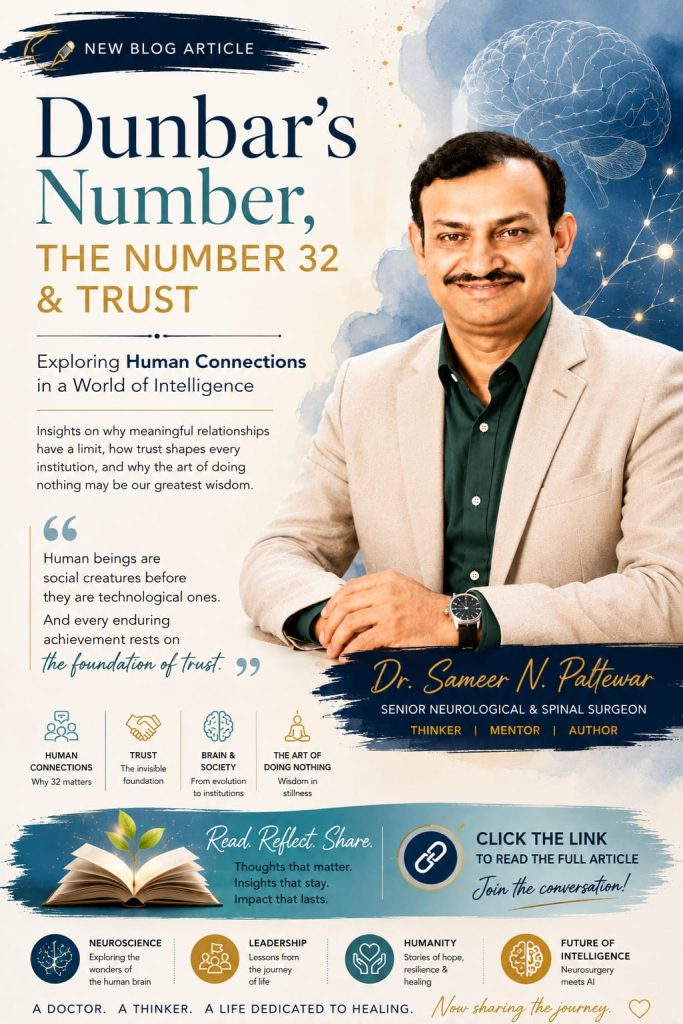
Human beings are social creatures before they are technological ones.
And every enduring achievement—whether a hospital, a company, a family, or a civilization—ultimately rests upon the fragile and beautiful foundation of trust.