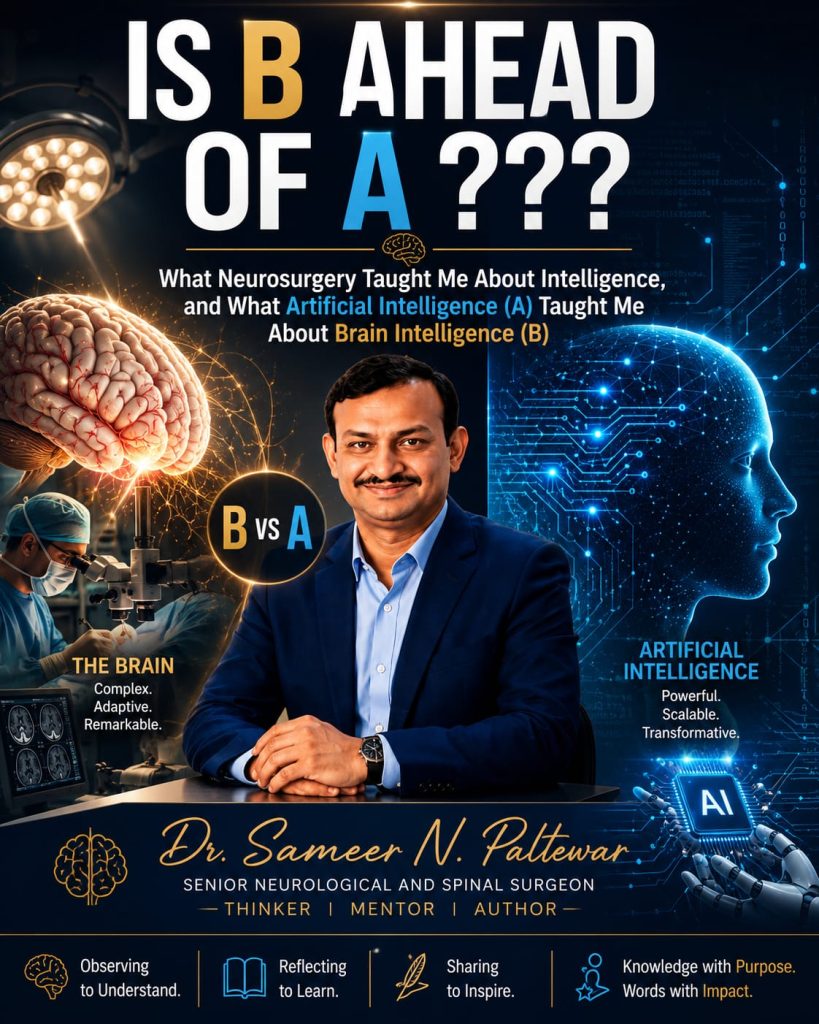
Introduction: Standing Between Two Revolutions
At 2 a.m., with a patient’s skull open and a ruptured aneurysm threatening catastrophic bleeding, I have often been struck by a simple fact: three pounds of tissue determine everything we call a human life. Memory, language, love, ambition, fear, and identity all reside within the most complex structure known to science.
For most of my career, I assumed the human brain would remain the most sophisticated system I would ever encounter.
As a neurosurgeon, I have operated on brains distorted by tumours, compressed by haemorrhages, and injured by trauma. I have watched patients lose speech from a lesion only millimetres wide and regain function after surgery that seemed impossible. The brain’s approximately 86 billion neurons and trillions of synaptic connections create a level of complexity that has challenged generations of scientists.
The brain felt like the final frontier.
Then artificial intelligence arrived.
Initially, I viewed AI as another useful medical technology. Computers had long assisted physicians by interpreting ECGs, analyzing imaging studies, and managing clinical records. None of that seemed remotely comparable to human cognition.
But the pace of change accelerated dramatically.
Within a few years, AI systems were writing essays, passing professional examinations, generating software, summarizing scientific literature, and engaging in conversations that often appeared remarkably human. GPT-4 scored near or above passing thresholds on multiple professional exams. AI models began outperforming specialists in selected image-recognition tasks. Suddenly, intelligence itself seemed open to engineering.
Ironically, AI did not primarily teach me about machines.
It taught me about the brain.
Neurosurgery taught me what intelligence truly is. Artificial intelligence taught me what intelligence is not.
The intersection of those lessons has reshaped how I think about medicine, consciousness, leadership, and the future of humanity.
The First Lesson: Intelligence Is Not Knowledge
Medical education rewards the accumulation of knowledge.
Students memorize anatomy, physiology, pathology, pharmacology, and thousands of clinical facts. Examinations test recall. Degrees certify mastery of information.
Yet every experienced surgeon eventually discovers a paradox.
The most knowledgeable physician in a room is not always the most intelligent.
I have seen trainees who could recite entire textbooks struggle when confronted with an unexpected intraoperative complication. I have also watched average students demonstrate exceptional judgment during emergencies.
The di erence is simple.
Intelligence is not information.
Intelligence is the ability to use information under real-world constraints.
A neurosurgeon facing an emergency rarely encounters textbook cases. Symptoms are incomplete. Imaging may be ambiguous. Families need answers immediately. Resources are finite.
The surgeon must decide.
That process resembles neither memorization nor calculation.
It is navigation through uncertainty.
Modern AI highlights the same distinction.
Large language models contain vast amounts of information, but their value lies in applying patterns learned from that information to unfamiliar situations. Knowledge is storage.
Intelligence is adaptation.
The brain taught me this lesson clinically.
AI revealed its computational significance.
The Second Lesson: The Brain Is a Prediction Machine
Traditional neuroscience often describes the brain as an information processor.
While true, that description is incomplete.
The brain does not merely react to reality.
It continuously predicts reality.
Every movement, perception, and thought depends on prediction.
When we walk, the brain predicts balance.
When we speak, it predicts sounds.
When we drive, it predicts trajectories.
When we diagnose disease, it predicts outcomes.
Patients often assume they perceive the world directly.
In reality, they experience the brain’s best model of the world.
Neurological disorders expose this principle vividly. Phantom limb syndrome causes patients to feel sensations in amputated limbs. Visual neglect can make half of reality e ectively disappear from awareness. Hallucinations reveal how strongly prediction shapes perception.
One case remains unforgettable. A patient arrived with a large acute subdural hematoma after a fall. His CT scan showed severe midline shift, his neurological status was deteriorating, and every minute mattered. We could not know with certainty whether emergency surgery would restore meaningful function or merely prolong severe disability. Yet delaying intervention carried its own risks. The decision depended on forecasting the future: how rapidly swelling would progress, how much viable brain remained, and what recovery might be possible. We operated immediately. Months later, the patient returned to clinic walking independently and conversing normally.
What struck me was those neurosurgical decision-making mirrors the brain itself. Faced with incomplete information, both surgeon and brain construct models, generate predictions, update beliefs, and act.
Modern AI reinforced this insight.
Large language models operate fundamentally through prediction. Given a sequence of words, they estimate what comes next.
At first glance, that sounds trivial.
Yet language encodes human knowledge, intention, emotion, and causality. Predicting language at scale requires capturing many of the structures underlying thought itself.
Remarkably, prediction can generate behavior that appears intelligent.
The more I studied AI, the more I appreciated that much of human intelligence may emerge from extraordinarily sophisticated predictive machinery.
The Third Lesson: Uncertainty Is the Natural State of Reality
Young physicians seek certainty.
Experienced physicians learn humility.
Neurosurgery is often portrayed as a discipline of precision.
The reality is more nuanced.
Every operation involves uncertainty.
Will the tumor separate safely from critical vessels?
Will neurological deficits improve?
Will postoperative swelling occur? Will recovery match expectations?
No surgeon possesses complete information.
We operate using probabilities.
Consider glioblastoma, one of the most aggressive brain tumors. Even with maximal surgery, radiation, and chemotherapy, median survival remains roughly 12 to 18 months. Yet individual outcomes vary dramatically. Some patients decline rapidly; others exceed expectations by years.
Medicine therefore becomes an exercise in updating probabilities as new evidence emerges.
Long before I encountered formal Bayesian theory, clinical practice had already taught me its principles. Every new symptom, laboratory result, or imaging study modifies our estimate of what is happening.
The brain appears to function similarly.
It constantly updates internal models using incoming evidence.
Every prediction error becomes an opportunity for learning.
Modern AI systems employ comparable principles. Machine learning improves performance by repeatedly adjusting models in response to data.
Brains learn through experience.
Machines learn through data.
Neither possesses certainty.
Both manage uncertainty.
In that sense, intelligence may be less about knowing truth than about navigating ambiguity effectively.
The Fourth Lesson: Intelligence Is Distributed
When I was younger, I imagined intelligence as something contained within individual brains.
Neurosurgery changed that perspective.
No surgeon operates alone.
A complex aneurysm clipping may involve anesthesiologists managing cerebral perfusion, nurses coordinating instruments, neurophysiologists monitoring function, radiologists interpreting imaging, and intensive care teams guiding recovery.
The operating room functions as a cognitive network.
Collective intelligence exceeds individual intelligence.
Research supports this observation. Studies of high-performing teams consistently show that communication quality and coordination often predict outcomes better than individual expertise alone.
This insight extends beyond medicine.
Human beings evolved as cooperative problem-solvers. Language, culture, science, and civilization emerged from networks of interacting minds.
Anthropologist Robin Dunbar proposed that humans can maintain roughly 150 stable social relationships. Organizational research has also observed that groups larger than about 30 people often require formal structures because informal coordination begins to break down.
The same pattern appears in technology.
Modern AI systems are not isolated algorithms. They depend on vast ecosystems of data, computing infrastructure, human feedback, and collaborative development.
Perhaps intelligence has never been purely individual.
Perhaps it has always been collective.
The Fifth Lesson: Consciousness and Intelligence Are Not the Same Thing
For centuries, humanity assumed intelligence and consciousness were inseparable.
Modern AI challenges that assumption.
Today’s most advanced models demonstrate impressive reasoning, planning, creativity, and problem-solving. Yet few researchers believe they possess subjective awareness.
This distinction forced me to reconsider neurological practice.
Patients with severe brain injuries sometimes retain consciousness despite profound cognitive limitations. Others can perform surprisingly complex behaviors while exhibiting altered awareness.
One of the most sobering experiences in neurosurgery is evaluating disorders of consciousness. A patient may open their eyes, move spontaneously, or respond inconsistently, leaving families and physicians struggling to determine what level of awareness remains.
Intelligence and consciousness appear related but distinct.
A calculator performs computation without awareness.
A sleeping person retains the capacity for consciousness despite limited active reasoning.
The brain combines both.
AI currently demonstrates one far more convincingly than the other.
Neurosurgery taught me that consciousness remains deeply mysterious.
AI taught me that intelligence may be easier to engineer than awareness.
That realization may prove one of the most important philosophical discoveries of our time.
The Sixth Lesson: The Brain Is Not a computer
The rise of AI has encouraged endless comparisons between brains and computers.
Some are useful.
Many are misleading.
The human brain consumes roughly 20 watts of power—less than many household light bulbs.
Training a state-of-the-art AI model can require thousands of specialized processors and consume millions of kilowatt-hours of electricity.
Brains learn continuously.
Machines often require extensive retraining.
Brains remain functional despite injury, noise, and incomplete information.
Machines remain comparatively fragile.
Most importantly, brains evolved.
Computers were designed.
Evolution optimizes survival rather than elegance. As a result, the brain contains redundancies, biases, and ine iciencies that engineers might never intentionally create.
Yet those apparent imperfections may contribute to its extraordinary adaptability.
The more capable AI becomes, the more remarkable biological intelligence appears.
Rather than diminishing my admiration for the brain, AI has amplified it.
The Seventh Lesson: Intelligence Requires Embodiment
Neurosurgeons encounter intelligence through living bodies.
Every thought is influenced by hormones, sensory inputs, metabolism, emotions, and physical constraints.
The brain never exists in isolation.
It exists within a body.
Clinical practice makes this impossible to ignore. Patients with endocrine disorders can experience profound cognitive and emotional changes. Sleep deprivation impairs judgment. Chronic pain alters attention and mood. Biology shapes thought.
Modern AI systems largely lack embodiment.
They process information but do not experience hunger, pain, fatigue, mortality, or desire.
This difference matters.
Human intelligence evolved to solve problems faced by embodied organisms.
Survival shaped cognition.
Emotion shaped memory.
Movement shaped perception.
The absence of embodiment may explain why machines can excel at language while struggling with aspects of common-sense physical reasoning that young children acquire naturally.
The brain reminds us that intelligence emerged from life, not merely computation.
The Eighth Lesson: Creativity Is Compression
One of the greatest surprises of modern AI has been its apparent creativity.
Machines write poetry.
Generate artwork.
Compose music.
Design proteins.
Produce scientific hypotheses.
How is this possible?
Neuroscience offers a clue.
Creativity is not magic.
It is recombination.
The brain compresses experiences into patterns and then recombines those patterns in novel ways.
The same principle appears throughout medicine. A surgeon confronting an unusual tumor may draw upon hundreds of prior cases, anatomical principles, and surgical techniques to devise a new solution. Innovation often emerges from connecting existing ideas in unexpected ways.
Machine learning appears to operate similarly.
Training compresses enormous amounts of information into mathematical representations.
Generation reconstructs novel combinations from those representations.
Both biological and artificial creativity may arise from the same underlying principle.
Compression creates understanding.
Recombination creates innovation.
The Ninth Lesson: Intelligence Has Economic Consequences
Historically, physical labor drove economies.
Industrialization mechanized muscle.
Artificial intelligence is beginning to mechanize cognition.
This transformation may rival or exceed the Industrial Revolution in scale.
When I examine hospitals, universities, corporations, governments, and financial institutions, I see systems built around the assumption that expertise is scarce.
Human intelligence has always been limited and expensive.
AI changes that equation.
In healthcare alone, clinicians spend substantial portions of their day on documentation, administrative tasks, and information retrieval. AI-assisted systems are already reducing some of that burden. Similar changes are occurring in law, finance, software development, and research.
The implications are profound.
Healthcare will change.
Education will change.
Research will change.
Management will change.
Entire professions will evolve.
The challenge is not merely technological.
It is societal.
Human institutions were built around biological limitations.
Artificial intelligence introduces a fundamentally new variable.
The Tenth Lesson: Wisdom Is Not Intelligence
Perhaps the most important lesson emerged from observing both brains and machines.
Intelligence is not wisdom.
A brilliant neurosurgeon can make poor life decisions.
A gifted scientist can behave irrationally.
An advanced AI can generate sophisticated analyses while lacking judgment.
Wisdom requires more than cognition.
It requires values.
Experience.
Perspective.
Humility.
Moral understanding.
One of the hardest conversations in neurosurgery is not technical but ethical: deciding when not to operate. The ability to perform a procedure does not automatically mean it should be performed. Those decisions depend on goals, values, quality of life, and human judgment.
The brain evolved not only to think but also to care.
Whether machines can ever acquire genuine wisdom remains unknown.
For now, that distinction offers reassurance.
Human significance does not disappear simply because machines become intelligent.
The qualities that make life meaningful extend beyond computation.
Conclusion: The Art of Doing Nothing
As I grow older, I find myself increasingly fascinated by a paradox.
The more we understand intelligence, the less certain we become about its essence.
Neurosurgery revealed the extraordinary complexity of the biological brain.
Artificial intelligence revealed the surprising power of computation.
Neither has solved the mystery of consciousness.
Neither has fully explained creativity.
Neither has answered why subjective experience exists.
Yet together they have illuminated each other.
The brain helped us build intelligent machines.
Intelligent machines are helping us understand the brain.
The dialogue between neuroscience and artificial intelligence may become one of the defining intellectual adventures of the twenty-first century.
And perhaps the deepest lesson is this:
Intelligence is not merely the ability to think.
It is the ability to adapt.
To learn.
To cooperate.
To imagine.
To remain curious in the face of uncertainty.
After decades in operating rooms and years reflecting on artificial minds, I have come to believe that intelligence is less like a machine and more like a journey.
The brain is not a finished object.
It is a process.
A conversation between prediction and reality.
Between memory and imagination.
Between self and society.
Between knowledge and wisdom.
In the end, neurosurgery taught me reverence for the brain.
Artificial intelligence taught me reverence for intelligence itself.
And the art of doing nothing taught me that understanding often emerges not when we are speaking, operating, calculating, or building, but when we pause long enough to observe the astonishing mystery that has been inside our skulls all along.