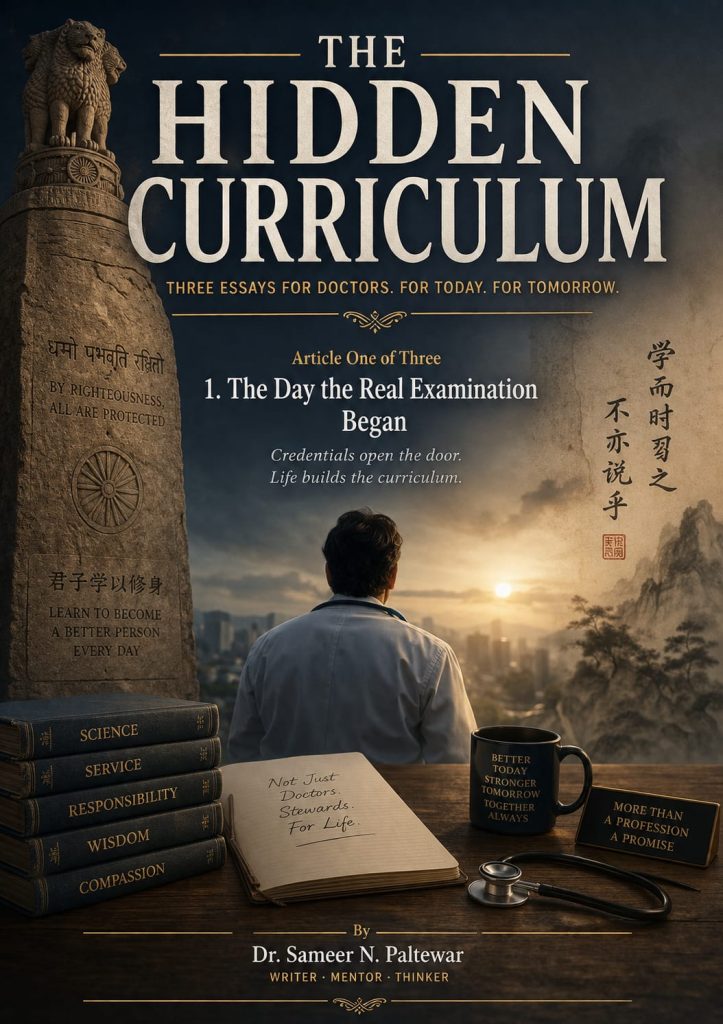
The Hidden Curriculum (Article One of Three)
1.The Day the Real Examination Began
INTRODUCTION:
Why I Wrote This Series?
There are moments in the life of a profession when silence is no longer wisdom.
Over the past few years, medicine has witnessed a disturbing convergence of events. Incidents of violence against doctors have become alarmingly frequent. Young resident doctors are struggling under relentless workloads, emotional exhaustion and burnout. Every examination season reminds us of another heartbreaking reality—the mounting psychological burden carried by NEET aspirants, some of whom never reach the profession they dreamed of serving. Meanwhile, practising doctors find themselves navigating an increasingly complex world of litigation, regulation, taxation, digital scrutiny, social media trials and public expectations that often extend far beyond the science of medicine itself.
These events are often discussed as isolated news stories.
They are not.
They are symptoms of a deeper misunderstanding about what it means to become—and remain—a doctor in the twenty-first century.
This series is not written to seek sympathy for doctors, nor to diminish the rights or expectations of patients. Trust in medicine is built upon accountability, transparency and compassion, and these values must never be compromised.
But trust also requires understanding.
Modern medicine has quietly evolved into one of the most demanding professions in society. It asks its practitioners to be scientists and communicators, clinicians and counsellors, leaders and lifelong learners, often while making irreversible decisions under conditions of profound uncertainty. Yet public conversations about medicine frequently reduce this complexity to simplistic narratives of success or failure, hero or villain.
The three essays that follow explore that hidden landscape.
They are not about defending a profession.
They are about understanding the psychology of responsibility, the invisible curriculum that every doctor must learn after graduation, and the emotional weight that no university can fully teach.
Ultimately, these essays are not only for doctors.
They are for patients, families, students, policymakers and anyone who has ever placed their trust in another human being at a moment when life was uncertain.
Because perhaps the future of healthcare depends not only on better medicines or better technology, but also on a deeper understanding between those who seek healing and those who dedicate their lives to providing it.
Every degree is an admission ticket. It is never the destination.
The Ticket, Not the Destination
Every doctor remembers the day they became one. The white coat. The degree, still warm from the printer. Photographs with proud parents standing a little too close, gripping an arm as if the moment might slip away. And beneath all of it, a quiet, almost sacred belief: the hardest examination of life has finally been put to rest.
They were wrong.
The degree was never a finish line. It was an admission ticket — not into medicine, but into reality. For sixteen years, medical school teaches the science of disease. The world then spends the next forty years teaching everything else, and unlike medical school, there is no syllabus, no textbook, no warning bell. Some truths can only be delivered by life itself — quietly, politely, one small tremor at a time.
“The degree was never a finish line. It
was an admission ticket — not into
medicine, but into reality.”
The Second Curriculum
A young doctor opens his first clinic. Patients begin to arrive. Success, he thinks. A few weeks later, the housing society sends a notice — too many patients are visiting this residential building. Another doctor receives a letter from the tax department: explain why GST does, or does not, apply to your practice. A third signs what looks like a prestigious hospital contract, and months later discovers that every clause protecting the hospital quietly transfers the risk to him. Someone wakes to a one-star review from a stranger who was never even a patient. Another is confronted by a television camera minutes after a complication no textbook could have prevented.
None of these appeared in the entrance examination. No professor ever announced, tomorrow we study how to negotiate an employment contract, or this afternoon’s lecture is on surviving social media. Medicine taught anatomy; life examined communication. Medicine taught pathology; practice demanded negotiation. Medicine taught surgery; reality required leadership. Somewhere between graduation and the first year of independent practice, every doctor discovers an uncomfortable, exhilarating truth — medicine is only one subject in the profession of being a doctor.
The Edicts on the Rock
In the third century BCE, the Mauryan emperor Ashoka faced a version of this same discovery at an imperial scale. He had already won Kalinga. He had already mastered the science of conquest — logistics, cavalry, siege, the entire curriculum of statecraft as his tutors had taught it to him. And then, standing on the field afterward, he understood that none of it had prepared him for what came next: how to govern a grieving population, how to build trust after devastation, how to translate remorse into policy rather than merely private feeling.
So, he did something no emperor before him had done at that scale. He had his answers carved into rock and pillar across the subcontinent — not proclamations of victory, but instructions in a curriculum nobody had taught him. Tolerance toward other sects. Kindness to animals and prisoners. The appointment of dhamma mahamatras, officers whose sole task was to check whether his governance was actually reaching the welfare of ordinary people, not merely the treasury. Ashoka had graduated as a conqueror. He spent the rest of his reign teaching himself, in public, on stone, how to become something the military academy of his age had never once examined him on: a steward of human beings.
The Gentleman Who Kept Studying
Five centuries earlier and a continent away, Confucius offered a description of a life that reads today like a syllabus written backward.
At fifteen, he said, his heart was set on learning.
At thirty, he stood firm.
At forty, he had no more doubts.
At fifty, he knew the mandate of heaven.
At sixty, his ear was obedient to truth.
At seventy, he could follow his heart’s desire without transgressing what was right.
Notice what this sequence is not. It is not a description of formal schooling, which for Confucius ended decades before the wisdom he is describing arrived. It is a description of an examination that ran continuously across an entire lifetime, administered not by an institution but by experience itself — governance, exile, poverty, the loss of a favourite student, the slow accumulation of situations no classical text had anticipated. The junzi, the Confucian gentleman, was not defined by the credentials he collected in his twenties. He was defined by his willingness to remain a student of life until the day he died. China’s oldest philosophical tradition and India’s oldest imperial one arrives, independently, at the identical discovery: credentials open the door. They do not furnish the house.
Every Profession Postpones the Same Lesson
This is not unique to medicine. It is simply more visible there, because the stakes are measured in life and death, and the fall from competence to catastrophe has no soft landing. The finest engineers eventually become managers. The best lawyers become negotiators. Scientists become administrators. Artists become entrepreneurs. Athletes become mentors. Every profession teaches competence. Life examines wisdom.
Medicine simply postpones this discovery longer than almost any other field. By the time a doctor completes MBBS, residency, and super-speciality fellowship, fifteen years or more have been spent inside an educational ecosystem that never once mentioned a balance sheet, a legal notice, a press interview, or the cold arithmetic of a one-star review. Then, almost overnight, they are expected to become employers, communicators, financial decision-makers, legal custodians, and institutional leaders. Not gradually. Immediately — the way a swimmer trained exclusively in a still pool is suddenly required to cross open water.
The Curriculum with No Professor
Educational psychologists have a name for this: the hidden curriculum — the lessons an institution never officially teaches, yet every student eventually learns by collision. How to earn trust before asking for consent. How to say I don’t know without losing a room’s confidence. How to apologise without legally admitting negligence. How to lead nurses twice your age. How to dismiss an employee with dignity intact on both sides. How to read a contract before it reads you. How to speak to a journalist during a crisis without making the crisis larger.
None of these appear in any textbook. Yet they frequently determine whether a career flourishes or quietly collapses underweight nobody warned it would have to carry.
“Every profession teaches competence.
Life examines wisdom — and life’s
examinations arrive without notice, in
the middle of an ordinary Tuesday.”
The Graduation Nobody Announces
The first real examination of any profession is not the one that awards a certificate. It is the one that arrives without notice — a legal letter, a viral review, a team that will not follow, a contract that was never meant to be fair. And the strange, humbling truth is this: the day you realise you were never fully prepared is the day your real education begins.
Perhaps the most important graduation ceremony does not happen when a university hands you a degree. Perhaps it happens years later, quietly, when you finally understand that every patient, every client, every crisis, every small private failure is a classroom — and this particular teacher never stops speaking, and never once collects a fee.
By
Dr. Sameer N. Paltewar
WRITER · MENTOR · THINKER