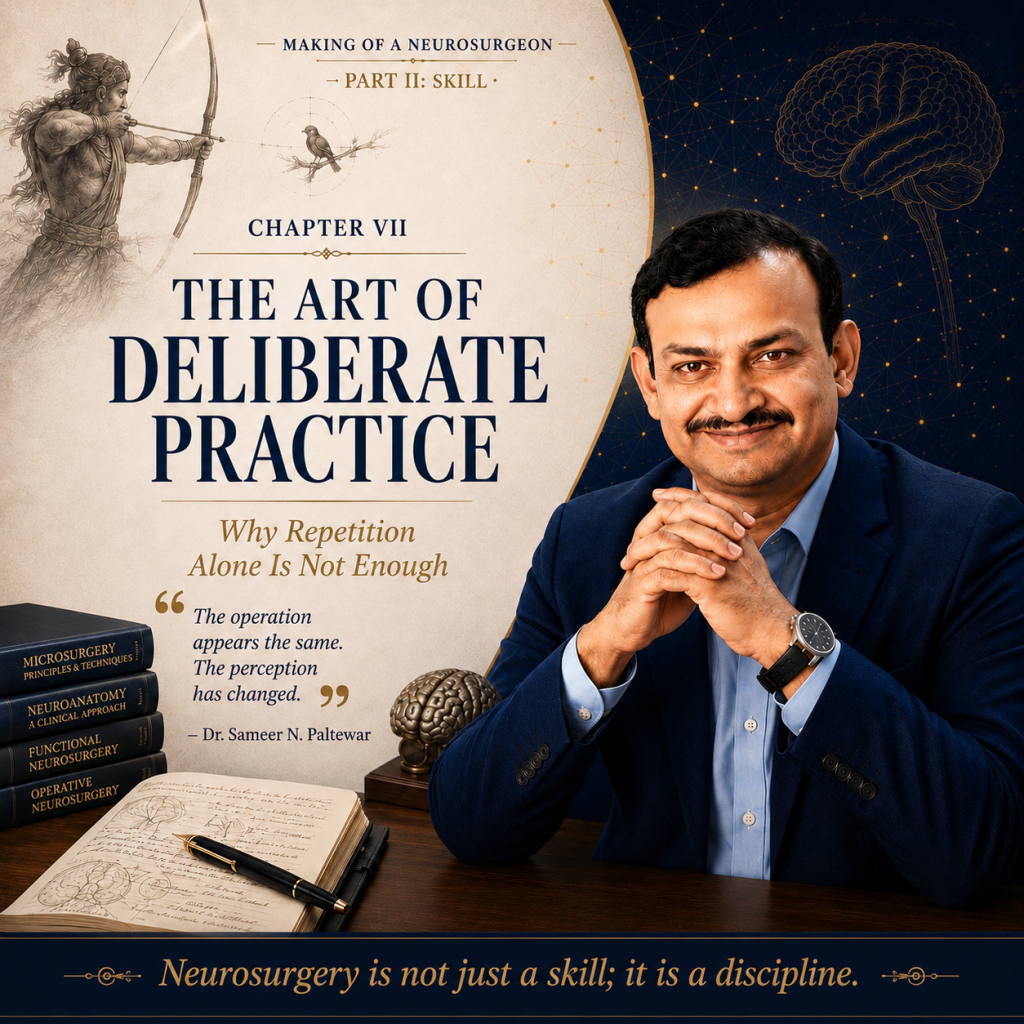
Making of a Neurosurgeon: The Art of Doing Nothing
Part II: Skill
Chapter VII: The Art of Deliberate Practice
Why Repetition Alone Is Not Enough
In the winter of 1985, a group of psychologists at Florida State University began a study that would quietly overturn one of the most comfortable assumptions in the history of human achievement.
The researchers, led by Anders Ericsson, wanted to understand what separated good violinists from great ones at the Music Academy of West Berlin. The student musicians had all entered the same conservatory, all studied under the same faculty, all had access to the same instruments, the same concert halls, the same peers. On paper, their developmental environments were nearly identical. Yet by the time they reached their late twenties, some had become genuinely exceptional — the kind of musicians who would go on to solo careers — while others had become, by every measure, merely very good.
Ericsson’s team asked the musicians to reconstruct, in detail, how they had spent their time since beginning serious study. The analysis produced a finding so clean it seemed suspicious: the musicians who had become exceptional had, by their early twenties, accumulated approximately ten thousand hours of *deliberate* practice — not time spent performing, or listening, or discussing music, but time spent in solitary, effortful work on specific technical difficulties, with explicit attention to errors and their correction.
The very good musicians had accumulated roughly eight thousand hours. The finding was not primarily about quantity. It was about *kind*. The exceptional musicians had spent more of their total practice time in the specific mode of practice that produces improvement — the uncomfortable, focused, error-confronting kind — and less in the mode that feels productive but mostly reinforces what is already known.
Ericsson spent the next three decades extending and refining this finding across chess, sport, medicine, and music. His conclusion, stated with the careful precision of someone who had studied its misinterpretations, was that the relationship between experience and expertise is neither automatic nor linear. You can spend ten thousand hours repeating what you already know and improve almost not at all. The hours matter only if the practice within them is structured around confronting, identifying, and correcting the specific things that are currently wrong.
This finding has implications for surgical training that the field has been slowly, unevenly absorbing — and that AI is about to force into sharper focus.
Arjuna’s Eye and What It Actually Required
The story of Dronacharya and the wooden bird is one of the most repeated pedagogical parables in the Indian tradition, and its surface meaning — that concentration produces mastery — has made it a staple of motivational literature across cultures.
But there is a dimension of the story that the surface reading tends to obscure.
When Arjuna says he sees only the eye of the bird, he is not merely describing a focused visual field. He is describing the product of years of deliberate training that Dronacharya had designed specifically to produce this capacity. The other students — Yudhishthira, Bhima, Duryodhana — were not less gifted in any absolute sense. They were less *prepared*, at this moment, to produce the specific kind of attention that the task required. The concentration was not something Arjuna summoned by will. It was something his training had made available to him.
Dronacharya understood something that modern performance psychology has formalised only recently: that what distinguishes experts from competent practitioners is not, primarily, superior natural ability. It is superior *perception*. The expert sees differently. Not because their visual apparatus is different, but because years of deliberate training have configured their attention — have taught it what to register and what to discard, what patterns to look for and what anomalies to flag.
The chess grandmaster doesn’t see more pieces than the novice. They see the *same* pieces organised into meaningful configurations that the novice’s eye cannot yet resolve. The experienced radiologist looking at a chest X-ray doesn’t have better vision than a medical student. They have trained attention — a perceptual system that has been recalibrated, through thousands of hours of feedback-guided practice, to detect the signals that matter.
In neurosurgery, this perceptual training is perhaps the most important thing that surgical education transmits, and the hardest to teach directly. A resident can be told, in explicit terms, every technical step of a posterior fossa craniotomy. What they cannot be told — what they must develop through extended exposure to real operative fields — is the perceptual capacity to see the surgical field as an experienced surgeon sees it: the tissue planes registered as a kind of topography, the vascular anatomy present not just as observed fact but as anticipated risk, the subtle changes in tissue colour and texture that signal proximity to something important.
The operation appears the same. The perception has changed.
This is the target of deliberate practice: not the repetition of actions, but the recalibration of attention.
The Musician Who Played the Same Note for Twenty Years
The Carnatic vocalist M.S. Subbulakshmi once said, in an interview late in her life, that she had spent sixty years learning to sing a single note correctly.
This sounds like the excessive modesty of a genuinely great artist — and it is partly that. But it is also partly literal.
In the Carnatic tradition, the gamaka — the ornament, the subtle pitch inflection that colours a note — is not a decoration applied to a melody. It is the melody. A phrase of four notes rendered with di erent gamakas is e ectively four di erent phrases, each carrying di erent emotional and raga-specific meaning. The di erence between an acceptable gamaka and a beautiful one is a matter of microseconds in timing, millihertz in pitch, and an almost indefinably subtle quality of breath control. This difference is not noticeable to an untrained ear. It is immediately, physically apparent to a trained one.
The student of Carnatic music spends years on a single raga — not because the other ragas are less important, but because the depth of a raga is e ectively infinite. Each repetition, under a teacher who has spent decades developing their own perceptual precision, reveals a layer of subtlety that the previous repetition could not. The student is not repeating the same thing. They are encountering the same thing at increasing resolution.
The neuroscience underlying this is now well-documented. The brain does not strengthen neural circuits merely through use. It strengthens them through *errorcorrected* use — through the cycle of attempt, mismatch between expected and actual outcome, and adjustment in response to that mismatch. This is what Ericsson’s musicians were doing in their solitary practice sessions: not playing pieces they already knew but identifying the specific measures where their execution diverged from their intention, and working on those measures, slowly and repeatedly, until the divergence narrowed.
The discomfort of this process is not incidental. It is the signal that learning is occurring. When practice feels easy, it is generally because you are rehearsing what you already know. When practice feels uncomfortable — when you are repeatedly confronting the gap between what you can do and what you are trying to do — you are at the boundary where neural circuits are actually being modified.
Surgeons know this boundary intimately, though they rarely describe it in these terms. It is the feeling of a procedure that is not quite under control — where you are managing it rather than executing it, where decisions require explicit thought rather than emerging from trained intuition. Operating in this zone, with appropriate supervision, is the mechanism by which surgical competence develops. Operating only within the comfortable zone of already-mastered techniques produces fluency without growth.
What the Plateau Actually Is
In 1926, the psychologist Bryan and Harter published what became known as the learning curve — a mathematical description of how skill acquisition typically follows a pattern of rapid initial improvement followed by a gradual flattening. They observed this in telegraph operators learning Morse code and proposed it as a general feature of skill acquisition.
What they also observed, and what has received less attention in the popular understanding of expertise, is that the plateau is not a ceiling. It is a reorganization point. The telegraph operators who eventually surpassed the plateau did so not by working harder at what they had been doing, but by fundamentally restructuring how they processed the information — moving from letter-by-letter decoding to word-level and phrase-level pattern recognition. The plateau marked the end of one cognitive strategy’s utility, not the limit of the operator’s potential.
This has been observed in virtually every complex skill domain since. The surgical resident who seems to stop improving after a period of rapid early progress has usually reached the limit of their current perceptual and cognitive framework — the limit of what their current way of seeing the operative field can support. Further improvement requires not more repetitions within that framework but a reorganisation of the framework itself, which typically requires the intervention of a teacher or mentor who can see the framework’s limitations from outside it.
This is precisely what Dronacharya was providing — not instruction in archery technique, which all the students were receiving, but a pedagogical challenge designed to force a reorganisation of perceptual strategy. “What do you see?” is not a question about vision. It is a diagnostic tool for identifying the learner’s current cognitive framework and creating the conditions for its expansion.
The rishi Patanjali, writing on yoga in the Yoga Sutras sometime in the first few centuries CE, described a phenomenon he called *vairagya* — a form of non-attachment that was not passivity but the active release of habitual patterns of perception and response, precisely in order to allow new, more refined ones to form. The practitioner who clings to their current level of proficiency — who practices only to confirm what they already know — cannot progress. Progress requires a willingness to temporarily become worse in the service of becoming better, to abandon the strategy that has stopped working in favour of one that the new level of skill requires.
Every significant advance in surgical skill I have experienced has felt like this. There is a period of disorientation — where the new approach I am trying to incorporate makes my performance, temporarily, less fluent than the approach it is replacing. The muscle memory of the old technique interferes with the acquisition of the new one. Experienced mentors normalize this. Inexperienced ones sometimes misread it as regression.
It is not regression. It is the plateau reorganising.
Kaizen, Kintsugi, and the Productive Relationship With Failure
The Japanese manufacturing philosophy of *kaizen* — continuous improvement through the systematic analysis and elimination of small ine iciencies — was developed in the post-war reconstruction of Japanese industry and contributed substantially to Japan’s emergence as a manufacturing power in the 1970s and 1980s. Its central insight was not technical but attitudinal: that improvement is not primarily the result of major innovations, but of the sustained, disciplined attention to small problems that most organisations choose to ignore because they seem too minor to address.
Toyota’s production system, built on kaizen principles, tracked defects not in terms of major failures — which were relatively rare and therefore attracted automatic attention — but in terms of minor deviations from standard that, left unaddressed, eventually produced major failures. The *andon cord* — which any worker on the Toyota assembly line could pull to stop the entire production line if they noticed a problem — was a physical embodiment of the kaizen principle: the cost of investigating and correcting a small error immediately is always less than the cost of incorporating that error into the finished product.
The parallel to surgical training is not metaphorical. It is direct.
The complications review — the morbidity and mortality conference that is standard in surgical departments — is the medical profession’s version of the andon cord: a regular, formalised occasion for examining what went wrong and why, without the defensive instinct to minimise or explain away that normally accompanies institutional failure. The best M&M conferences I have attended are genuinely uncomfortable. Cases are presented in detail. Decisions that turned out to be wrong are examined not to assign blame but to understand the reasoning that produced them — and the systemic or cognitive factors that made that reasoning available at the time.
What is being practised in these conferences is the same capacity that deliberate practice develops at the individual level: the ability to examine one’s own performance with the honesty and precision necessary to identify what actually went wrong, as opposed to a version of events that is comfortable to live with.
There is a related Japanese aesthetic concept that I find equally instructive: *kintsugi* — the art of repairing broken pottery with gold, so that the fracture lines become features rather than flaws. The repaired object is not pretending the break didn’t happen. It is incorporating the break into what the object has become. The history of damage is visible, and the visibility is considered a form of beauty.
The surgeon who has made a serious intraoperative error — who has injured a vessel they did not intend to injure, or misjudged the extent of a tumour’s involvement with eloquent cortex — and who has lived honestly with that error, examined it without evasion, and carried it into subsequent operations as a permanent feature of their operative consciousness, is a di erent surgeon from the one who has never made that error. Not necessarily better in every respect. But possessed of a specific knowledge — a kinesthetic and emotional memory of what that error feels like and what it requires — that cannot be acquired any other way.
The gold in the fracture lines.
The Feedback Desert
For most of human history, the fundamental constraint on deliberate practice was not motivation or time. It was *feedback*.
Ericsson’s study showed that what di erentiated the practice of exceptional musicians from merely good ones was not the total hours but the quality of error-correcting feedback within those hours. The solitary student practicing in their room, without a teacher to identify what they were doing wrong, often reinforced errors rather than correcting them — building fluency in a flawed technique that eventually became harder to unlearn than it would have been to avoid.
This feedback constraint has been even more severe in surgery than in music, because the surgical field contains feedback signals that are genuinely di icult to read, especially for a novice. The experienced surgeon who tells a resident “You’re in the wrong plane” is providing feedback that the resident cannot yet fully decode — because recognising the right plane is precisely the perceptual capacity they are trying to develop. The feedback is correct. The recipient doesn’t yet have the apparatus to fully use it.
This is what makes AI-augmented surgical training potentially transformative in a way that goes beyond accelerating volume. The motion-tracking systems and outcomeprediction models being developed don’t merely provide more feedback. They provide feedback that is calibrated to what the learner’s current performance data suggests they need — identifying the specific phase of the procedure where technique diverges from expert norms, the particular instrument movement that consistently precedes an adverse outcome, the decision point where this resident’s choices systematically di er from those of experienced surgeons.
This is personalised feedback at a resolution that no individual mentor, however attentive, can consistently provide. It is, in Ericsson’s terms, the engineering of the conditions that produce deliberate practice rather than merely effortful repetition.
The danger — which I think bears stating plainly — is that feedback without interpretation can produce compliance without understanding. A resident who adjusts their technique in response to algorithmic feedback, without understanding *why* the adjusted technique is better, has improved their performance without developing the perceptual and cognitive capacity that makes their improvement durable and generalisable. They have learned to satisfy the metric. They have not necessarily learned to see.
The role of the human mentor, in an AI-augmented training environment, becomes precisely this: not to deliver feedback that the system can deliver more precisely, but to interpret the feedback — to help the trainee understand not just what the system is measuring but why those measurements matter, and what the gap they reveal feels like from the inside of the surgical field.
The Surgeon’s Notebook
Leonardo da Vinci kept notebooks throughout his working life — not as diaries, but as working documents, filled with drawings, observations, calculations, questions, and provisional conclusions that he returned to, revised, and built upon across decades. More than thirteen thousand pages survive. They show a mind not merely accumulating knowledge but in continuous dialogue with its own errors — repeatedly drawing the same anatomical structure from different angles, noting where the previous drawing was wrong, attempting to capture in line what the previous attempt had missed.
Leonardo’s notebooks are the most visible surviving example of a practice that runs through the development of expertise in almost every domain: the discipline of externalising one’s thinking in a form that can be examined, critiqued, and revised. The act of writing forces a precision of thought that internal reflection alone does not require. The mistake that seemed plausible in the moment looks di erent when it is written down and returned to a week later.
In surgery, the equivalent has traditionally been the operative note — the formal record of what was done and why, dictated after the procedure. At its best, the operative note is a document of genuine clinical reasoning: this is what the imaging showed, this is what I found, this is why I made the decisions I made, this is what I would do differently. At its worst — and operative notes frequently function at their worst — it is a bureaucratic record dictated by rote, containing the information the medical record requires without the reflection that learning demands.
The surgical log that most training programmes require residents to maintain is similarly variable in its value. A log of cases performed is useful as a record of volume. It becomes useful as a learning tool only when it includes, alongside the case type and the date, the resident’s honest account of what went wrong, what surprised them, what they wish they had done differently, and what they intend to do about it.
What AI can do for this reflective process is not replace it but augment it — providing objective data alongside subjective reflection, so that the resident’s account of their own performance can be tested against what the sensors and the outcome records actually show. The surgeon who believes they maintained a clean field throughout a procedure, but whose motion data shows three minutes of uncontrolled bleeding that they then masked with packing has access, through the data, to a corrective that their memory alone would not provide.
The notebook becomes more honest when it has the data to argue with.
What Mastery Actually Feels Like From the Inside
I want to say something about mastery that is rarely said plainly in surgical literature, because surgical culture tends to valorise confidence and certainty in ways that make honest uncertainty professionally uncomfortable.
Mastery does not feel like certainty.
It feels like an increasingly refined capacity to navigate uncertainty — to act decisively in conditions where the available information is incomplete, the right answer is genuinely unclear, and the consequences of error are real and immediate. The master surgeon is not less uncertain than the novice about some things. They are uncertain about different things, at a higher level of resolution.
The novice is uncertain about what they are seeing. The master is uncertain about what it means. The novice is uncertain about how to execute the step. The master is uncertain about whether this is the right step. The novice is managing the operation. The master is asking whether this is the right operation.
This is what Ericsson meant, I think, when he described deliberate practice as occurring at “the edge of competence.” The edge of competence is not a comfortable place. It is the place where you don’t quite know if what you’re doing is right, and you are attending carefully enough to notice whether it is. Expertise is the development of an increasingly sensitive instrument for detecting your own uncertainty — and the capacity to continue acting effectively while in that state.
In the Yoga Sutras, Patanjali describes the highest states of meditative practice not as states of certainty or bliss but as states of refined, transparent awareness — where the practitioner perceives with extraordinary clarity precisely because they have ceased imposing their habitual frameworks of interpretation onto what they are perceiving. The perception becomes, in some sense, more honest.
I think of this sometimes in surgery, in the moments when an operation has departed from plan and I am navigating genuinely unfamiliar territory. The cognitive state that is required is not confidence in the conventional sense — not the feeling of knowing what to do. It is something more like alert receptivity: a quality of attention that is neither panicked nor falsely certain, that is genuinely present to what is happening in the operative field and genuinely responsive to what it finds there.
This capacity is the destination of deliberate practice. Not fluency, not speed, not the elimination of di iculty — but the development of a self that can remain honest and attentive even when the situation is difficult. That can see clearly even when what it sees is uncertainty.
Arjuna saw only the eye of the bird.
The practice of decades had given him that eye.
What the practice had actually done was teach him to see.
A Final Thought on the Practice Room
There is a room in every serious musician’s life that nobody else sees.
Not the concert hall. Not the masterclass. Not the recording studio. The practice room — small, often bare, frequently unglamorous — where the musician returns, day after day, to the specific passages that aren’t working, the specific technical problems that resist resolution, the specific gap between what they can do and what the music requires.
The concert is what the world sees. The practice room is where the concert is built.
Surgery has its equivalent in every form: the anatomy lab, the simulation centre, the cadaveric dissection, the complications review, the late-night operative video studied frame by frame. These are the spaces where, away from the performance pressure of the operating theatre and the expectations it carries, a surgeon can afford to be wrong — can attend honestly to their own errors and work, methodically and patiently, on closing the gap.
The future of this work will look di erent from its past. The feedback will be more precise. The simulations will be more faithful. The data will be more comprehensive. AI will identify what the surgeon’s own attention misses.
But the work itself — the returning, the confronting, the correcting, the returning again will require exactly what it has always required. The willingness to see yourself clearly. The patience to accept that improvement is slow. The discipline to keep coming back anyway. No technology has ever been able to provide these things. No technology ever will. They are not features of a training system.
They are features of a person.
And they are built, as they have always been built, in the room that nobody else sees.